Novel chemometric-driven greenness assessed spectroscopical method development and forced degradation study of sitagliptin phosphate in its bulk drug and ophthalmic formulation
DOI:
https://doi.org/10.69857/joapr.v14i4.2331Keywords:
Antidiabetic Drug, UV-visible spectrophotometer, Stability under stress conditions, Forced degradation study, Degradation productsAbstract
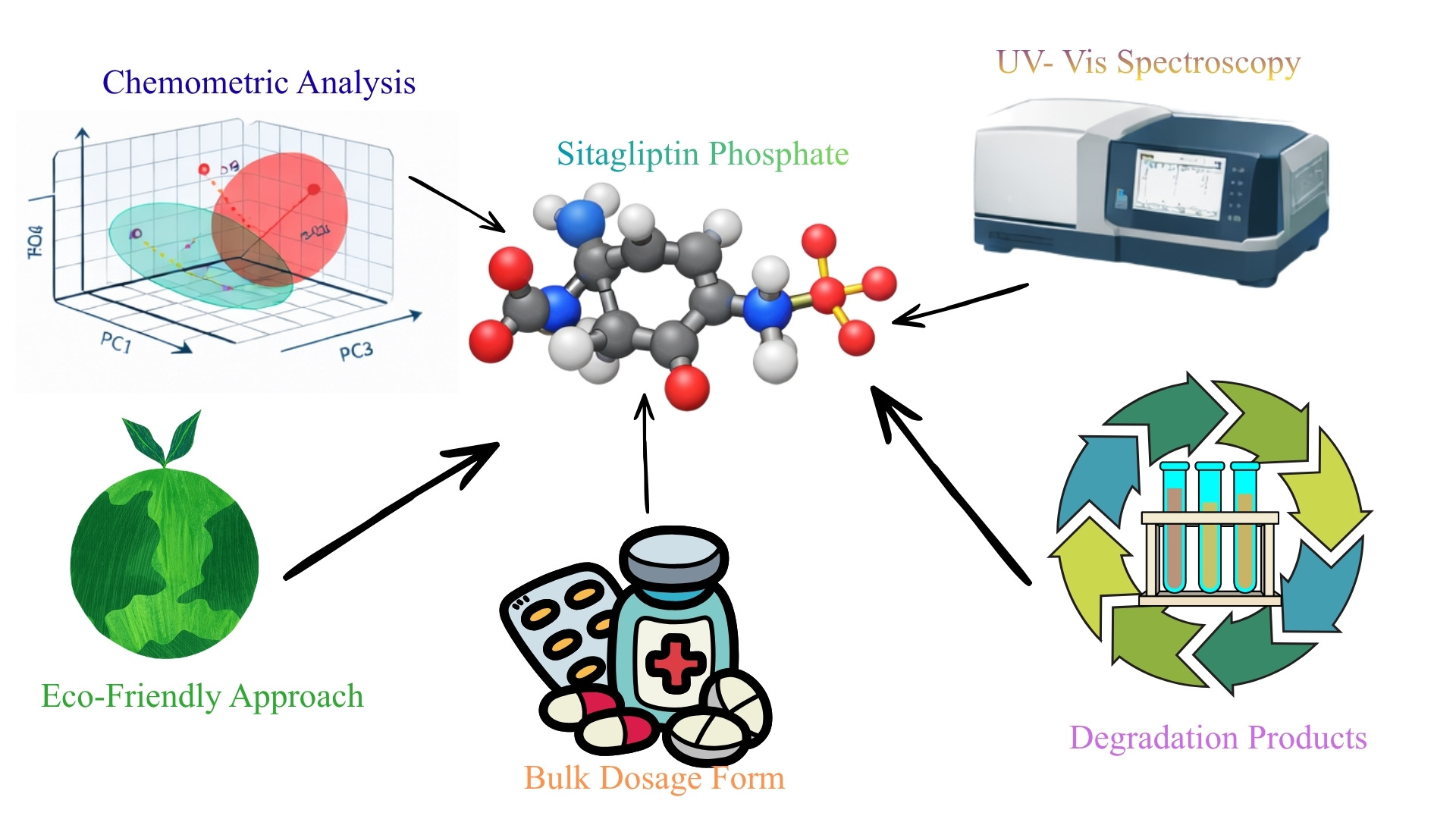
Background: Sitagliptin phosphate (SIT), an antidiabetic drug, requires reliable analytical methods for routine quality control and stability assessment. UV-visible spectrophotometry offers a simple and economical approach; however, method robustness and stability-indicating capability must be ensured using systematic development strategies such as Quality by Design (QbD). The objective of this work is to develop and validate a rapid, simple, economical, accurate, and precise UV-visible spectrophotometric method with a stability-indicating capability for the analysis of SIT in bulk drug and ophthalmic formulation. Methodology: Method development was performed using a QbD approach in a quality control laboratory with a UV-visible spectrophotometer and 1 cm quartz cells. Various solvents (phosphate buffer, ethanol, acetonitrile, methanol, and water) were evaluated, with water selected due to superior solubility and spectral characteristics. SIT showed maximum absorbance at 265-267 nm. Forced degradation studies (acidic, basic, oxidative, thermal, and photolytic) were conducted. Validation was performed as per ICH Q2 (R1) guidelines. Results and Discussion: The developed method exhibited excellent linearity (R² ≥ 0.998), accuracy (99-101% recovery), and precision (%RSD ≤ 2%). Recovery ranged from 98.68% to 99.46%. The method was robust and successfully indicated stability under stress conditions. The application of QbD ensured systematic optimization and robustness. Water proved to be an ideal solvent, enhancing method simplicity and cost-effectiveness. The method effectively distinguished SIT from degradation products, confirming its stability-indicating nature. Conclusion: A validated, reliable, and economical UV-visible spectrophotometric method was successfully developed for SIT analysis, suitable for routine quality control and stability studies in bulk drug and ophthalmic formulations.
Downloads

References
Al-Farhan BS, Eldin GMG. Chemometric-assisted UV-Vis spectrophotometric method for the simultaneous quantification of triple anthelmintics in veterinary pharmaceuticals. Sci Rep, 15, 1–13 (2025) https://doi.org/10.1038/s41598-025-31003-3
Falcioni R, Gonçalves JV, de Oliveira KM, de Oliveira CA, Reis AS, Crusiol LG, et al. Chemometric analysis for the prediction of biochemical compounds in leaves using UV-VIS-NIR-SWIR hyperspectroscopy. Plants, 12, 1–10 (2023) https://doi.org/10.3390/plants12193424
Baraily VR, Mandhadi JR, Shrestha B. Spectrophotometric methods for determination of naringin, amlodipine, and nifedipine using chemometric techniques. J Appl Pharm Res, 13(3), 154–163 (2025) https://doi.org/10.69857/joapr.v13i3.1107
Lakumalla D, Podichety N, Maddali R. Design and characterization of glimepiride hydrotropic solid dispersion to enhance the solubility and dissolution. J Appl Pharm Res, 12(2), 68–78 (2024) https://doi.org/10.18231/j.joapr.2024.12.2.68.78
Yorulmaz H, Cavdaroglu C, Donmez O, Serpen A, Ozen B. Year-to-year differentiation of black tea through spectroscopic and chemometric analysis. Eur Food Res Technol, 251, 535–544 (2025) https://doi.org/10.1007/s00217-024-04650-5
Abidola TB, Olaoye J, Benson KP, Obaloluwa PA, Lawan AB, Tunde K. Chemometric analysis of heavy metal contamination in water sources: a risk assessment approach. Int J Sci Res Mod Technol, 16, 16–23 (2025) https://doi.org/10.38124/ijsrmt.v4i3.375
Jena D, Jabeen A, Mahato AD, Choudhary K, Mahato R, Chakraborty P, et al. Optimizing encorafenib validation: a quality by design approach empowered by green chemistry. Int J Pharm Investig, 15, 524–530 (2025) https://doi.org/10.5530/ijpi.20250120
Adejuwon EO, Ogwueleka TC, Ogungbemi EO, Prabhu R, Rendon-Nava A, Yates K. Assessment of surface water quality using chemometric tools: a case study of Jabi Lake, Abuja, Nigeria. Iran J Sci Technol Trans Civ Eng, 49, 829–852 (2025) https://doi.org/10.1007/s40996-024-01712-2
García-Barrera LJ, Meza-Zamora SA, Noa-Carrazana JC, Delgado-Macuil RJ. Chemometric analysis using infrared spectroscopy and PCA-LDA for early diagnosis of Fusarium oxysporum in tomato. J Plant Dis Prot, 131, 1609–1626 (2024) https://doi.org/10.1007/s41348-024-00978-y
Mishra K, Dash A, Jabeen A, Vegesna S, Sahoo SK, Gupta V, et al. Chemometric assisted UV-spectrophotometric quantification of tigecycline in parenteral dosage form. Int J Drug Deliv Technol, 13, 976–981 (2023) https://doi.org/10.25258/ijddt.13.3.33
Chen M, Song J, He H, Yu Y, Wang R, Huang Y, et al. Quantitative analysis of high-price rice adulteration based on near-infrared spectroscopy combined with chemometrics. Foods, 13, 1–12 (2024) https://doi.org/10.3390/foods13203241
Shinde KS, Jangme CM, Patil AR. RP-HPLC method for quantitative estimation of naftifine hydrochloride in formulated products: development and validation. J Appl Pharm Res, 13(4), 177–186 (2025) https://doi.org/10.69857/joapr.v13i4.1115
Mamede R, Santos A, da Silva EF, Patinha C, Calado R, Ricardo F. New evidence of fraudulent mislabeling and illegal harvesting of Manila clams (Ruditapes philippinarum) through elemental fingerprints and chemometric analyses. Food Control, 163, 110501 (2024) https://doi.org/10.1016/j.foodcont.2024.110501
Mishra K, Padmasri B, Vegesna S, Jabeen A, Dash A, Kumar S, et al. Chemometric assisted UV-spectrophotometric quantification of cefaclor in suspension dosage form. Int J Pharm Qual Assur, 14, 734–739 (2023) https://doi.org/10.25258/ijpqa.14.3.46
Li W, Liang C, Bao F, Zhang T, Cheng Y, Zhang W, et al. Chemometric analysis illuminates the relationship among browning, polyphenol degradation, Maillard reaction and flavor variation of jujube fruits during air-impingement jet drying. Food Chem X, 22, 101425 (2024) https://doi.org/10.1016/j.fochx.2024.101425
Feng J, Zhang B, Zhang H, Wu Z, Li M, Wang D, et al. Combining E-nose, GC-MS, GC-IMS and chemometrics to explore volatile characteristics during different stages of Zanthoxylum bungeanum fruits. Food Res Int, 195, 114964 (2024) https://doi.org/10.1016/j.foodres.2024.114964
Javed NM. A review of dipeptidyl peptidase-4 (DPP-4) and its potential synthetic derivatives in the management of diabetes mellitus. J Angiother, 8, 1–12 (2024) https://doi.org/10.25163/angiotherapy.819417
P N S S, Adikay S. A QbD-based stability-indicating RP-HPLC method for larotrectinib: degradation kinetics and integrated white, green, and blue analytical assessment. J Appl Pharm Res, 13(4), 143–161 (2025) https://doi.org/10.69857/joapr.v13i4.1436
Haque SM, Jain R, Umar Y, Judeh AA, Alahmari SD, Alam M, et al. Design of experiment (DoE), screening and optimization of system variables to develop and validate greener spectrophotometric investigation of repaglinide. Chem Africa, 7, 5225–5243 (2024) https://doi.org/10.1007/s42250-024-01131-w
do Nascimento Lopes ID, Fujimori SK, de Carvalho Mendes T, de Almeida RA, de Sousa FF, de Oliveira CA, et al. Application of analytical quality by design (AQbD) for stability-indicating method development for quantification of nevirapine and its degradation products. Microchem J, 199, 109939 (2024) https://doi.org/10.1016/j.microc.2024.109939
Published
How to Cite
Issue
Section
Copyright (c) 2026 Debashis Mishra, Himansu Bhusan Samal, Diptimayee Jena, Kirtimaya Mishra

This work is licensed under a Creative Commons Attribution-NonCommercial 4.0 International License.