Enhanced selectivity in alpelisib quantification in human plasma: a validated LC-MS/MS method with deuterated internal standard
DOI:
https://doi.org/10.69857/joapr.v14i4.2268Keywords:
Alpelisib, LC-MS/MS, bioanalysis, validation of methods, monitoring of therapeutic drugs, human plasmaAbstract
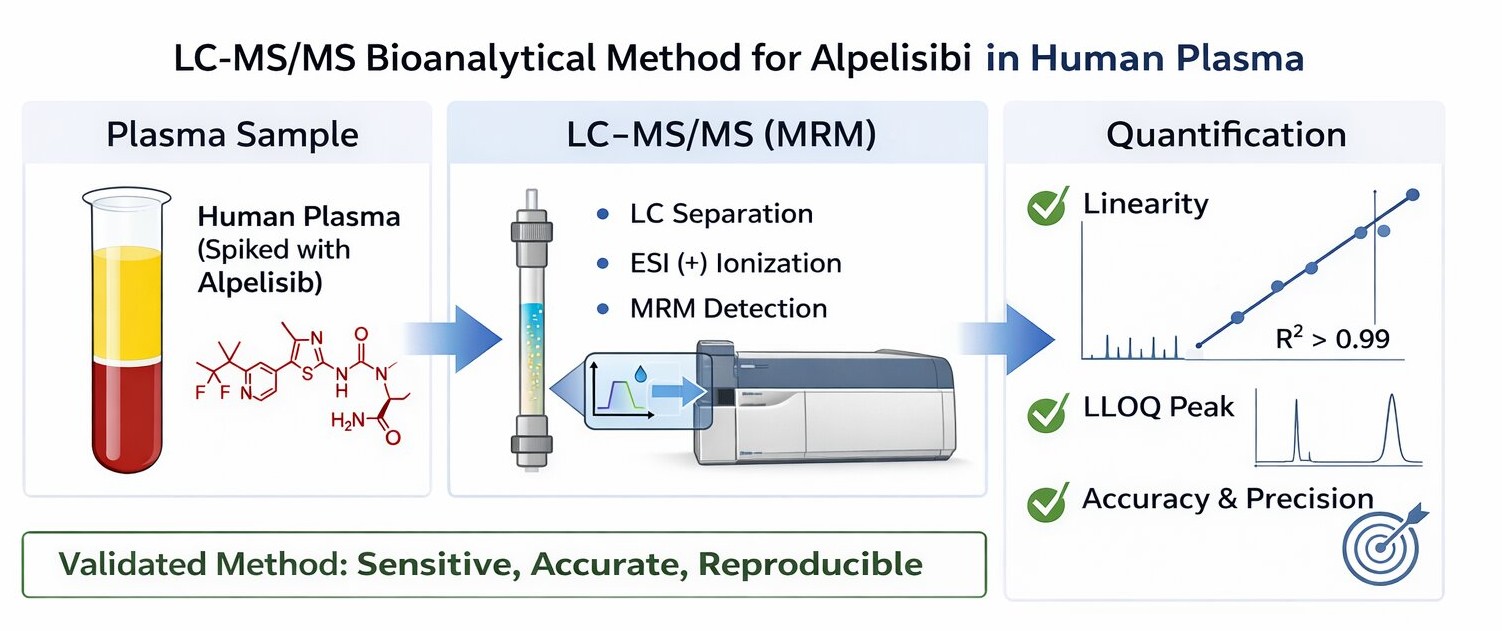
Background: To enhance efficacy and manage dose-limiting toxicities such as hyperglycemia, therapeutic drug monitoring of alpelisib (ALB), a phosphatidylinositol 3-kinase alpha (PI3Kα) inhibitor used in advanced breast cancer, is essential. This study aimed to develop and validate a selective, sensitive, and high-throughput liquid chromatography-tandem mass spectrometry (LC-MS/MS) method for the quantification of ALB in human plasma to support pharmacokinetic studies and therapeutic drug monitoring. Methodology: Alpelisib-D3 was used as a deuterated internal standard (IS). Analytes were extracted from 50 µL of plasma by liquid-liquid extraction using n-hexane and methyl tert-butyl ether (20:80, v/v). Chromatographic separation was performed on an X-Terra RP8 column using an isocratic mobile phase of 5 mM ammonium acetate buffer (pH 5.00) and acetonitrile (10:90, v/v) at 0.4 mL/min. Detection was carried out in positive electrospray ionization mode using multiple reaction monitoring of m/z 442.15→141.07 for ALB and m/z 445.36→144.05 for the IS. Validation included linearity, precision, accuracy, recovery, matrix effect, carryover, dilution integrity, and stability. Results and discussion: The method was linear over 50.0–10,000 ng/mL. Intra- and inter-day precision (CV%) was <4.2%, and accuracy ranged from 94.5% to 106.2%. Mean extraction recovery exceeded 90%, with no significant matrix effects. Carryover, stability, and dilution integrity also met acceptance criteria. Conclusion: A reliable, sensitive, and selective LC-MS/MS method was successfully developed and validated. The method is suitable for high-throughput pharmacokinetic studies and therapeutic drug monitoring of ALB in human plasma.
Downloads

References
André F, Ciruelos E, Rubovszky G, Campone M, Loibl S, Rugo HS, et al. Alpelisib for PIK3CA-mutated, hormone receptor-positive advanced breast cancer. N. Engl. J. Med., 380(20), 1929–1940 (2019) https://doi.org/10.1056/NEJMoa1813904
Tan A, Fanaras JC. Use of high-pH (basic/alkaline) mobile phases for LC-MS or LC-MS/MS bioanalysis. Biomed. Chromatogr., 33(1), e4409 (2019) https://doi.org/10.1002/bmc.4409
Peleg Hasson S, Rubinek T, Ryvo L, Wolf I. Endocrine resistance in breast cancer: Focus on the phosphatidylinositol 3-kinase/Akt/mammalian target of rapamycin signaling pathway. Breast Care, 8(4), 248–255 (2013) https://doi.org/10.1159/000354757
Markham A. Alpelisib: First global approval. Drugs, 79(11), 1249–1253 (2019) https://doi.org/10.1007/s40265-019-01161-6
Rugo HS, André F, Yamashita T, Cerda H, Toledano I, Stemmer SM, et al. Time course and management of key adverse events during the randomized phase III SOLAR-1 study of PI3K inhibitor alpelisib plus fulvestrant in patients with HR-positive advanced breast cancer. Ann. Oncol., 31(8), 1001–1010 (2020) https://doi.org/10.1016/j.annonc.2020.05.001
Armaghani AJ, Han HS. Alpelisib in the treatment of breast cancer: A short review on the emerging clinical data. Breast Cancer Targets Ther., 12, 251–258 (2020) https://doi.org/10.2147/BCTT.S219436
Miricescu D, Totan A, Stanescu-Spinu II, Badoiu SC, Stefani C, Greabu M. PI3K/AKT/mTOR signaling pathway in breast cancer: From molecular landscape to clinical aspects. Int. J. Mol. Sci., 22(1), 173 (2021) https://doi.org/10.3390/ijms22010173
Srivastava S, Upadhye V J, Prasad M E, Singh P. Applications of bioactive compounds of traditional Chinese medicine in breast cancer management. Journal of Applied Pharmaceutical Research, 13(4), 1-15 (2025) https://doi.org/10.69857/joapr.v13i4.935
Tankova T, Mrinakova B, Frolova M. Management strategies for hyperglycemia associated with the α-selective PI3K inhibitor alpelisib for the treatment of breast cancer. Cancers, 14(7), 1598 (2022) https://doi.org/10.3390/cancers14071598
Costa RLB, Han HS, Gradishar WJ. Targeting the PI3K/AKT/mTOR pathway in triple-negative breast cancer: A review. Breast Cancer Res. Treat., 169(3), 397–406 (2018) https://doi.org/10.1007/s10549-018-4697-y
James A, Hazell K, Trandafir L, et al. Absorption, distribution, metabolism, and excretion of BYL719 (alpelisib) in healthy male volunteers. Cancer Chemother. Pharmacol., 76(4), 751–760 (2015) https://doi.org/10.1007/s00280-015-2835-9
De Buck SS, Jakab A, Boehm M, et al. Population pharmacokinetics and pharmacodynamics of BYL719, a phosphoinositide 3-kinase antagonist, in adult patients with advanced solid malignancies. Br. J. Clin. Pharmacol., 78(3), 543–555 (2014) https://doi.org/10.1111/bcp.12354
Seo SW, Kim JM, Han DG, Geum D, Yun H, Yoon IS. A sensitive HPLC-FLD method for the quantification of alpelisib in rat plasma: Drug metabolism and pharmacokinetic evaluation in vitro and in vivo. J. Chromatogr. B, 1163, 122508 (2021) https://doi.org/10.1016/j.jchromb.2020.122508
Wang Q, Lan X, Zhao Z. Characterization of alpelisib in rat plasma by a newly developed UPLC-MS/MS method: Application to a drug-drug interaction study. Front. Pharmacol., 12, 725384 (2021) https://doi.org/10.3389/fphar.2021.725384
Lee S, Kim MS, Jeong JW. Bioanalysis of alpelisib using liquid chromatography–tandem mass spectrometry and application to pharmacokinetic study. J. Anal. Sci. Technol., 13, 31 (2022) https://doi.org/10.1186/s40543-022-00340-7
James AD, Marvalin C, Luneau A, et al. Comparison of ^19F NMR and ^14C measurements for the assessment of ADME of BYL719 (alpelisib) in humans. Drug Metab. Dispos., 45(8), 900–907 (2017) https://doi.org/10.1124/dmd.117.075051
Cai HL, Deng Y, Fang PF, Cao S, Hou ZY, Wu YQ, et al. A sensitive LC-MS/MS method for analysis of pericyazine in presence of 7-hydroxypericyazine and pericyazine sulphoxide in human plasma and its application to a comparative bioequivalence study in Chinese healthy volunteers. J. Pharm. Biomed. Anal., 135, 67–74 (2017) https://doi.org/10.1016/j.jpba.2016.12.007
Tiwari G, Tiwari R. Bioanalytical method validation: An updated review. Pharm. Methods, 1(1), 25–38 (2010) https://doi.org/10.4103/2229-4708.72226
Kaza M, Karaźniewicz-Łada M, Kosicka K, Siemiątkowska A, Rudzki PJ. Bioanalytical method validation: New FDA guidance vs. EMA guideline. Better or worse? J. Pharm. Biomed. Anal., 165, 381–385 (2019) https://doi.org/10.1016/j.jpba.2018.12.030
Published
How to Cite
Issue
Section
Copyright (c) 2026 Venkateswararao Agraharapu, Venkata Rao Vutla, Suryadevara Vidyadhara

This work is licensed under a Creative Commons Attribution-NonCommercial 4.0 International License.