Quality by design based optimization and physicochemical characterization of flucytosine nanoemulsion
DOI:
https://doi.org/10.69857/joapr.v14i4.2247Keywords:
Pathogenic fungi, Nanoemulsion, Box-Behnken design (BBD), Antifungal drugs, BioavailabilityAbstract
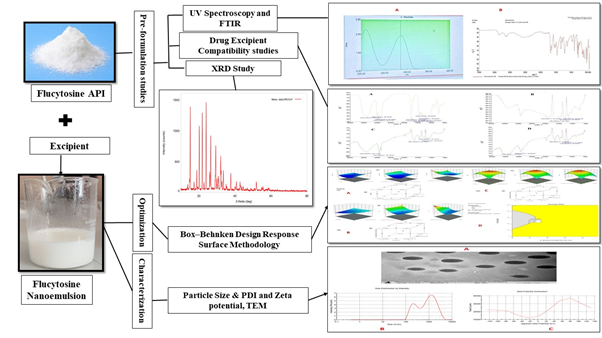
Background: The rise of pathogenic fungi capable of infecting people is a major public health problem. Flucytosine is an effective antifungal agent, but its clinical use is constrained by rapid clearance and dose-related adverse effects. Nanoemulsion-based systems offer a promising strategy for drug delivery and therapeutic performance. The objective of this work was to develop and optimize a flucytosine-loaded nanoemulsion using a Quality by Design (QbD) approach based on the Box-Behnken design, and to evaluate its physicochemical characteristics. Methodology: A Box-Behnken design (BBD) was used to optimize formulation factors, including lipid concentration, Smix (surfactant-to-cosurfactant) ratio, and homogenization time, using high-speed homogenization. The impacts on particle size, polydispersity index, and entrapment efficiency (EE) were investigated. UV-visible spectroscopy, Fourier-transform infrared spectroscopy (FTIR), and X-ray diffraction (XRD) were used to assess the compatibility and stability of the improved formulation (F11) with the chosen excipients. Results and Discussion: The optimized formulation (F11) had a particle size of 318.18 nm and a PDI of 0.136, a zeta potential of -22.2 mV, and high entrapment efficiency (96.36%), indicating good stability and uniformity. Preformulation and compatibility studies confirmed the absence of drug-excipient interactions. Statistical analysis demonstrated that formulation variables significantly influenced critical quality attributes. Conclusion: The study demonstrates that QbD-driven optimization can successfully develop a stable and efficient flucytosine nanoemulsion with enhanced drug-loading capacity and potential to improve antifungal therapy. However, further studies, including in vitro drug release, in vivo evaluation, long-term stability, and clinical validation, are required to confirm its performance in drug delivery applications.
Downloads

References
Lockhart SR, Chowdhary A, Gold JAW. The rapid emergence of antifungal-resistant human-pathogenic fungi. Nat Rev Microbiol, 21, 818–832 (2023) https://doi.org/10.1038/s41579-023-00960-9
Gorle A, Ahire K, Shende R. Design, development and characterization of nanoemulsion developed by high pressure homogenization (HPH) method containing antifungal drug. J Drug Deliv Ther, 12, 24–32 (2022) https://doi.org/10.22270/jddt.v12i2.5245
Sigera LSM, Denning DW. Flucytosine and its clinical usage. Ther Adv Infect Dis, 10, 20499361231161388 (2023) https://doi.org/10.1177/20499361231161
Miot J, Leong T, Takuva S, Parrish A, Dawood H. Cost-effectiveness analysis of flucytosine as induction therapy in the treatment of cryptococcal meningitis in HIV-infected adults in South Africa. BMC Health Serv Res, 21, 1–11 (2021) https://doi.org/10.1186/s12913-021-06268-9
Sastré-Velásquez LE, Dallemulle A, Kühbacher A, Baldin C, Alcazar-Fuoli L, Niedrig A, et al. The fungal expel of 5-fluorocytosine derived fluoropyrimidines mitigates its antifungal activity and generates a cytotoxic environment. PLoS Pathog, 18, e1011066 (2022) https://doi.org/10.1371/journal.ppat.1011066
Salmanton-García J. Update on invasive fungal infections: emerging trends in the incidence of fungal infections in immunosuppressed patients and associated conditions. Ther Adv Infect Dis, 11 (2024) https://doi.org/10.1177/20499361241282835
Iyer KR, Revie NM, Fu C, Robbins N, Cowen LE. Treatment strategies for cryptococcal infection: challenges, advances and future outlook. Nat Rev Microbiol, 19, 454–466 (2021) https://doi.org/10.1038/s41579-021-00511-0
Akkuş İ, Kaçmaz B. Antifungal drugs. J Curr Hematol Oncol Res, 1, 41–46 (2023) https://doi.org/10.51271/JCHOR-0010
Hilpert K, Rumancev C, Gani J, Collis DWP, Lopez-Perez PM, Garamus VM, et al. Can BioSAXS detect ultrastructural changes of antifungal compounds in Candida albicans? — an exploratory study. Front Pharmacol, 14, 1141785 (2023) https://doi.org/10.3389/fphar.2023.1141785
Shaker DS, Ishak RAH, Ghoneim A, Elhuoni MA. Nanoemulsion: a review on mechanisms for the transdermal delivery of hydrophobic and hydrophilic drugs. Sci Pharm, 87, 17 (2019) https://doi.org/10.3390/scipharm87030017
Nikolaev B, Yakovleva L, Fedorov V, Li H, Gao H, Shevtsov M. Nano- and microemulsions in biomedicine: from theory to practice. Pharmaceutics, 15, 1989 (2023) https://doi.org/10.3390/pharmaceutics15071989
Tayeb HH, Felimban R, Almaghrabi S, Hasaballah N. Nanoemulsion: formulation, characterization, biological fate, and potential role against COVID-19 and other viral outbreaks. Colloid Interface Sci Commun, 45, 100533 (2021) https://doi.org/10.1016/j.colcom.2021.100533
Rampado R, Peer D. Design of experiments in the optimization of nanoparticle-based drug delivery systems. J Control Release, 358, 398–419 (2023) https://doi.org/10.1016/j.jconrel.2023.05.001
Yadav P, Rastogi V, Verma A. Application of Box–Behnken design and desirability function in the development and optimization of self-nanoemulsifying drug delivery system for enhanced dissolution of ezetimibe. Futur J Pharm Sci, 6, 1–20 (2020) https://doi.org/10.1186/s43094-020-00023-3
Kamdi DB, Yerne HM, Patil SR. Development and validation of UV spectroscopic method for estimation of fluconazole in tablet dosage form. Am J PharmTech Res, 10, 83–92 (2020) https://doi.org/10.46624/ajptr.2020.v10.i1.008
Tkachenko Y, Niedzielski P. FTIR as a method for qualitative assessment of solid samples in geochemical research: a review. Molecules, 27, 8846 (2022) https://doi.org/10.3390/molecules27248846
Gupta M, Tiwari P. Formulation and in-vitro evaluation of oxaprozin transdermal patches for sustained anti-inflammatory therapy. J Appl Pharm Res, 13, 22–32 (2025) https://doi.org/10.69857/joapr.v13i6.1203
Ali A, Chiang YW, Santos RM. X-ray diffraction techniques for mineral characterization: a review for engineers of the fundamentals, applications, and research directions. Minerals, 12, 205 (2022) https://doi.org/10.3390/min12020205
Jufri M, Mun'im A, Zulfakar MH. Development and optimization of asiaticoside nanoemulsion formulation by Box-Behnken design. Farmacia, 72 (2024) https://doi.org/10.31925/farmacia.2024.6.19
Chaturvedi S, Garg A. Development and optimization of nanoemulsion containing exemestane using Box-Behnken design. J Drug Deliv Sci Technol, 80, 104151 (2023) https://doi.org/10.1016/j.jddst.2023.104151
Mahapatra APK, Saraswat R, Botre M, Paul B, Prasad N. Application of response surface methodology (RSM) in statistical optimization and pharmaceutical characterization of a patient compliance effervescent tablet formulation of an antiepileptic drug levetiracetam. Futur J Pharm Sci, 6, 1–14 (2020) https://doi.org/10.1186/s43094-020-00096-0
Safhi AY, Naveen NR, Rolla KJ, Bhavani PD, Kurakula M, Hosny KM, et al. Enhancement of antifungal activity and transdermal delivery of 5-flucytosine via tailored spanlastic nanovesicles: statistical optimization, in-vitro characterization, and in-vivo biodistribution study. Front Pharmacol, 14, 1321517 (2023) https://doi.org/10.3389/fphar.2023.1321517
Shi Y, Zhang M, Chen K, Wang M. Nano-emulsion prepared by high pressure homogenization method as a good carrier for Sichuan pepper essential oil: preparation, stability, and bioactivity. LWT, 154, 112779 (2022) https://doi.org/10.1016/j.lwt.2021.112779
Jacob S, Kather FS, Boddu SHS, Shah J, Nair AB. Innovations in nanoemulsion technology: enhancing drug delivery for oral, parenteral, and ophthalmic applications. Pharmaceutics, 16, 1333 (2024) https://doi.org/10.3390/pharmaceutics16101333
Ahmad N, Ahmad R, Al-Qudaihi A, Alaseel SE, Fita IZ, Khalid MS, et al. Preparation of a novel curcumin nanoemulsion by ultrasonication and its comparative effects in wound healing and the treatment of inflammation. RSC Adv, 9, 20192–20206 (2019) https://doi.org/10.1039/c9ra03102b
Anwer MK, Aldawsari MF, Iqbal M, Almutairy BK, Soliman GA, Aboudzadeh MA. Diosmin-loaded nanoemulsion-based gel formulation: development, optimization, wound healing and anti-inflammatory studies. Gels, 9, 95 (2023) https://doi.org/10.3390/gels9020095
Rasmussen MK, Pedersen JN, Marie R. Size and surface charge characterization of nanoparticles with a salt gradient. Nat Commun, 11, 2337 (2020) https://doi.org/10.1038/s41467-020-15889-3
Ahmad N, Ahmad R, Ahmad FJ, Ahmad W, Alam MA, Amir M, et al. Poloxamer-chitosan-based naringenin nanoformulation used in brain targeting for the treatment of cerebral ischemia. Saudi J Biol Sci, 27, 500–517 (2020) https://doi.org/10.1016/j.sjbs.2019.11.008
Farooq U, Rasul A, Zafarullah M, Abbas G, Rasool M, Ali F, et al. Nanoemulsion as novel nanocarriers for drug delivery across the skin: in-vitro, in-vivo evaluation of miconazole nanoemulsion for treatment of Candidiasis albicans. Des Monomers Polym, 24, 240–258 (2021) https://doi.org/10.1080/15685551.2021.1965724
Maharini I, Martien R, Nugroho AK, Supanji S, Adhyatmika A. Validation UV spectrophotometric method to determine entrapment efficiency of ocular polymeric nanoparticle levofloxacin hemihydrate. Res J Pharm Technol, 14, 5479–5482 (2021) https://doi.org/10.52711/0974-360X.2021.00956
Das T, Venkatesh MP, Kumar TMP, Koland M. SLN based alendronate in situ gel as an implantable drug delivery system — a full factorial design approach. J Drug Deliv Sci Technol, 55, 101415 (2020) https://doi.org/10.1016/j.jddst.2019.101415
Jain P, Taleuzzaman M, Kala C, Kumar Gupta D, Ali A, Aslam M. Quality by design (QbD) assisted development of phytosomal gel of aloe vera extract for topical delivery. J Liposome Res, 31, 381–388 (2021) https://doi.org/10.1080/08982104.2020.1849279
Gohil D, Shah N, Maheshwari RA. Effect of formulation variables on fabrication of risperidone loaded nanoparticles for sustained drug delivery. Indian J Pharm Educ Res, 56, 58–64 (2022) https://doi.org/10.5530/ijper.56.1.8
Gupta B, Poudel BK, Pathak S, Tak JW, Lee HH, Jeong JH, et al. Effects of formulation variables on the particle size and drug encapsulation of imatinib-loaded solid lipid nanoparticles. AAPS PharmSciTech, 17, 652–662 (2016) https://doi.org/10.1208/s12249-015-0384-z
Aggarapu S, Galla R, Shaik NJ, Dasari SJ. Application of Plackett–Burman and Box–Behnken designs to develop a sensitive and robust HPLC method for quantifying hypolipidemic drugs, rosuvastatin and bempedoic acid in tablets. Futur J Pharm Sci, 11, 61 (2025) https://doi.org/10.1186/s43094-025-00814-6
Kurakula M, Naveen NR, Patel B, Manne R, Patel DB. Preparation, optimization and evaluation of chitosan-based avanafil nanocomplex utilizing antioxidants for enhanced neuroprotective effect on PC12 cells. Gels, 7, 96 (2021) https://doi.org/10.3390/gels7030096
Parmar K, Bharatia R. Novel flucytosine loaded in-situ gel for the management of ocular infections. Prospect Pharm Sci, 23, 75–83 (2025) https://doi.org/10.56782/pps.350
Bakhaidar RB, Naveen NR, Basim P, Murshid SS, Kurakula M, Alamoudi AJ, et al. Response surface methodology (RSM) powered formulation development, optimization and evaluation of thiolated based mucoadhesive nanocrystals for local delivery of simvastatin. Polymers (Basel), 14, 5184 (2022) https://doi.org/10.3390/polym14235184
Albertsen CH, Kulkarni JA, Witzigmann D, Lind M, Petersson K, Simonsen JB. The role of lipid components in lipid nanoparticles for vaccines and gene therapy. Adv Drug Deliv Rev, 188, 114416 (2022) https://doi.org/10.1016/j.addr.2022.114416
Algahtani MS, Ahmad MZ, Ahmad J. Investigation of factors influencing formation of nanoemulsion by spontaneous emulsification: impact on droplet size, polydispersity index, and stability. Bioengineering, 9, 384 (2022) https://doi.org/10.3390/bioengineering9080384
Alhakamy NA, Badr-Eldin SM, Ahmed OAA, Aldawsari HM, Okbazghi SZ, Alfaleh MA, et al. Green nanoemulsion stabilized by in situ self-assembled natural oil/native cyclodextrin complexes: an eco-friendly approach for enhancing anticancer activity of costunolide against lung cancer cells. Pharmaceutics, 14, 227 (2022) https://doi.org/10.3390/pharmaceutics14020227
Gawin-Mikołajewicz A, Nawrot U, Malec KH, Krajewska K, Nartowski KP, Karolewicz BL. The effect of high-pressure homogenization conditions on the physicochemical properties and stability of designed fluconazole-loaded ocular nanoemulsion. Pharmaceutics, 16, 11 (2023) https://doi.org/10.3390/pharmaceutics16010011
Khaleseh F, Barzegar-Jalali M, Zakeri-Milani P, Islambulchilar Z, Valizadeh H. Optimum surfactant concentration for preparation of amiodarone loaded solid lipid nanoparticles: theoretical estimation versus experimental results by Box-Behnken design. J Rep Pharm Sci, 12 (2023) https://doi.org/10.5812/jrps-146155
Srivastava R, Rawat AKS. Formulation and evaluation of flucytosine-loaded nanoemulgel for enhanced antifungal activity through in vitro and in vivo studies. J Appl Pharm Res, 13, 1–13 (2025) ⚠️ DOI not provided — please supply if available
Souto EB, Cano A, Martins-Gomes C, Coutinho TE, Zielińska A, Silva AM. Microemulsions and nanoemulsion in skin drug delivery. Bioengineering, 9, 158 (2022) https://doi.org/10.3390/bioengineering9040158
Yakoubi S, Kobayashi I, Uemura K, Nakajima M, Isoda H, Ksouri R, et al. Essential-oil-loaded nanoemulsion lipidic-phase optimization and modeling by response surface methodology (RSM): enhancement of their antimicrobial potential and bioavailability in nanoscale food delivery system. Foods, 10, 3149 (2021) https://doi.org/10.3390/foods10123149
Mohammed NK, Muhialdin BJ, Meor Hussin AS. Characterization of nanoemulsion of Nigella sativa oil and its application in ice cream. Food Sci Nutr, 8, 2608–2618 (2020) https://doi.org/10.1002/fsn3.1500
Preeti, Sambhakar S, Malik R, Bhatia S, Al Harrasi A, Rani C, et al. Nanoemulsion: an emerging novel technology for improving the bioavailability of drugs. Scientifica (Cairo), 2023, 6640103 (2023) https://doi.org/10.1155/2023/6640103
Aldosari BN, Ibrahim MA, Alqahtani Y, El Sayeh AF. Formulation and evaluation of fluconazole nanosuspensions: in vitro characterization and transcorneal permeability studies. Saudi Pharm J, 32, 102104 (2024) https://doi.org/10.1016/j.jsps.2024.102104
Published
How to Cite
Issue
Section
Copyright (c) 2026 Rajat Srivastava , Ajay Kumar Singh Rawat

This work is licensed under a Creative Commons Attribution-NonCommercial 4.0 International License.