Factors influencing anti-osteoporotic medicine consumption in Uzbekistan: A descriptive analysis
DOI:
https://doi.org/10.69857/joapr.v14i4.2090Keywords:
Bone mineral density, densitometry, drug accessibility, pharmaceutical policy, population agingAbstract
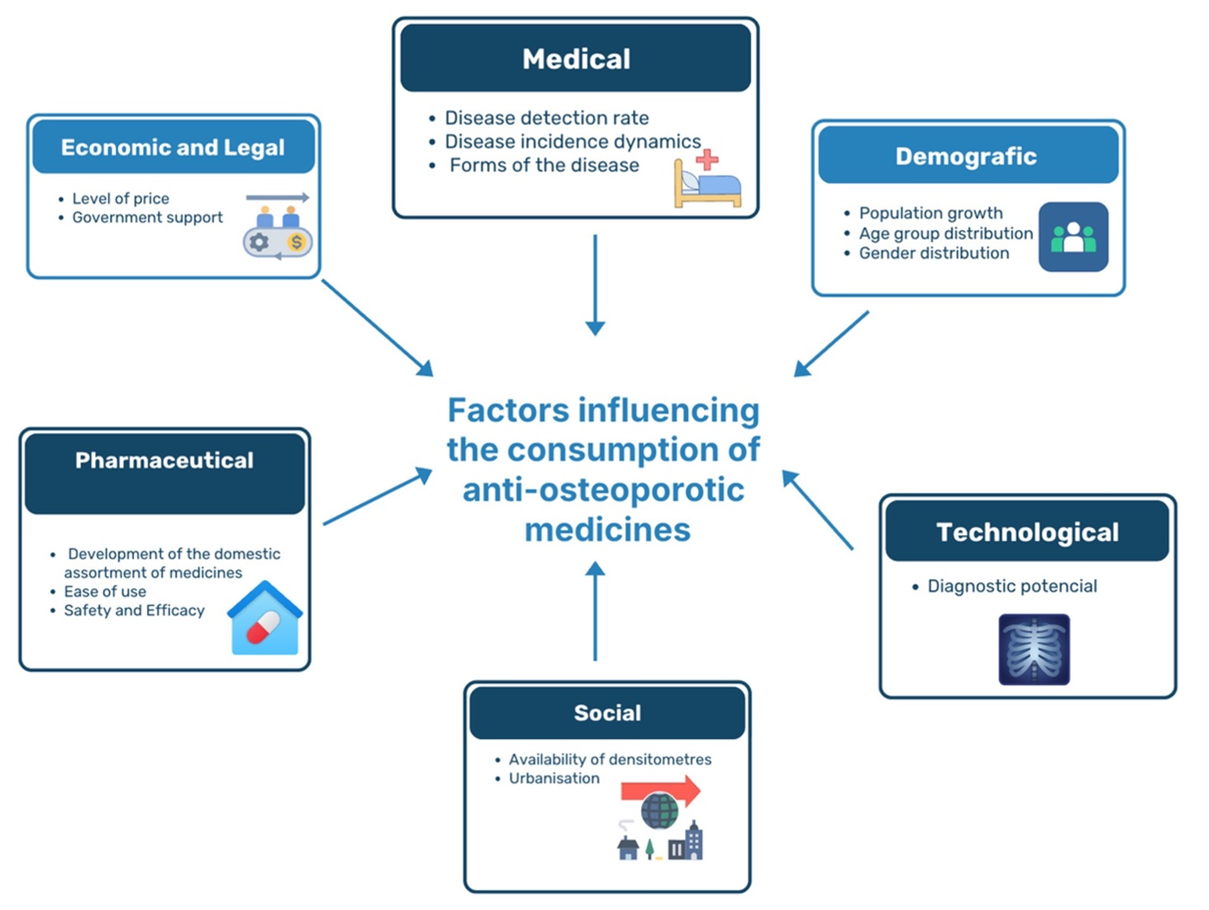
Background: Osteoporosis is an increasing public health burden in Uzbekistan, driven by demographic changes and limited access to timely diagnosis and treatment. This study aims to identify key determinants influencing the consumption of anti-osteoporotic medicines (AOMs). Methodology: A multifactor analytical approach was applied using descriptive, grouping, and correlational methods, as well as compound annual growth rate (CAGR) analysis. Because the annual series deviated from normality, associations between variables were assessed using Spearman’s rank correlation coefficient (ρ). As CAGR is a descriptive indicator, the statistical significance of temporal change was additionally evaluated using Spearman’s rank-based trend analysis. Results: Osteoporosis incidence increased by 95% between 2016 and 2024, with pronounced regional variability. The national CAGR was 9%, although the monotonic national time trend did not reach statistical significance (ρ = 0.533, p = 0.139). In RSSPMTO data, the correlation between annual population size and the combined number of osteoporosis/osteopenia cases was moderate when 2022 was included (ρ = 0.60, exact p = 0.350) and higher after exclusion of the 2022 peak (ρ = 0.80, exact p = 0.333). Still, neither association reached statistical significance, likely due to the small number of observations. Discussion: The findings indicate that medical, demographic, and technological factors, particularly limited diagnostic capacity and uneven regional detection, may influence AOMs consumption. Conclusion: Improving access to AOMs in Uzbekistan requires expanding densitometry services, implementing screening programs, and strengthening pharmaceutical policy through reference pricing, domestic production incentives, and price regulation.
Downloads

References
Amin U, McPartland A, O'Sullivan M, Silke C. An overview of the management of osteoporosis in the aging female population. Womens Health (Lond), 19, 17455057231176655 (2023) https://doi.org/10.1177/17455057231176655
Zadjali FA, Brooks J, O'Neill TW, Stanmore E. Impact of postmenopausal osteoporosis on the lives of Omani women and the use of cultural and religious practises to relieve pain: a hermeneutic phenomenological study. Health Expect, 26(6), 2278–2292 (2023) https://doi.org/10.1111/hex.13824
Vijayakumar S, Parimalakrishnan S, Prem Anand DC, Monisha S, Vishnuvarthini, Vijayakumar AR. The rising global burden of osteoporosis: insights into prevalence, fracture rates, and future trends. Int J Basic Clin Pharmacol, 14(4) (2025) https://doi.org/10.18203/2319-2003.ijbcp20251847
Zakroyeva AG, Babalyan V, Gabdulina G, Lobanchenko O, Ershova OB, Issaeva S, et al. Burden of osteoporosis in the countries of the Eurasian region. Osteoporos Bone Dis, 23(4), 19–29 (2021) https://doi.org/10.14341/osteo12700
Yusupova ZK, Saipova DT. Marketing analysis of the assortment of bone resorption inhibitors. Pharm J, (5), 15–19 (2024)
Yusupova ZK, Saipova DT. Trends and marketing analysis of osteoporosis therapeutic drugs in Uzbekistan. Int J Multidiscip Res, 7(6), 1–12 (2025) https://doi.org/10.36948/ijfmr.2025.v07i06.59707
Kumar S, Khurana A, Haglin J, Khurana R, Hidlay D, Eltorai AE. Trends in Medicare reimbursement for interventional radiology procedures: 2007–2020. Cureus, 15(8), e43840 (2023) https://doi.org/10.7759/cureus.43840
Hou W, Chen S, Zhu C, Gu Y, Zhu L, Zhou Z. Associations between smoke exposure and osteoporosis or osteopenia in a US NHANES population of elderly individuals. Front Endocrinol, 14, 1074574 (2023) https://doi.org/10.3389/fendo.2023.1074574
Hsu SH, Chen LR, Chen KH. Primary osteoporosis induced by androgen and estrogen deficiency: the molecular and cellular perspective on pathophysiological mechanisms and treatments. Int J Mol Sci, 25(22), 12139 (2024) https://doi.org/10.3390/ijms252212139
Amarnath SS, Kumar V, Das SL. Classification of osteoporosis. Indian J Orthop, 57(Suppl 1), 49–54 (2023) https://doi.org/10.1007/s43465-023-01058-3
Sapra L, Saini C, Garg B, Gupta R, Verma B, Mishra PK, et al. Long-term implications of COVID-19 on bone health: pathophysiology and therapeutics. Inflamm Res, 71(9), 1025–1040 (2022) https://doi.org/10.1007/s00011-022-01616-9
Fuggle NR, Singer A, Gill C, Patel A, Medeiros A, Mlotek AS, et al. How has COVID-19 affected the treatment of osteoporosis? An IOF-NOF-ESCEO global survey. Osteoporos Int, 32(4), 611–617 (2021) https://doi.org/10.1007/s00198-020-05793-3
Chellamuthu L, Mary JJF, Palanichamy S. Osteoporosis Knowledge Assessment Tool (OKAT-T): validity and reliability study. J Clin Orthop Trauma, 60, 102845 (2025) https://doi.org/10.1016/j.jcot.2024.102845
See H, Gowling E, Boswell E, Aggarwal P, King K, Smith N, et al. Treatment considerations for severe osteoporosis in older adults. Drugs Aging, 42(5), 395–412 (2025) https://doi.org/10.1007/s40266-025-01205-5
Zhu Z, Yu P, Wu Y, Wu Y, Tan Z, Ling J, et al. Sex-specific global burden of osteoporosis in 204 countries and territories, 1990–2030: an age-period-cohort modeling study. J Nutr Health Aging, 27(9), 767–774 (2023) https://doi.org/10.1007/s12603-023-1971-4
Bhat G, Ireland A, Shah N, et al. Bone health and its association with lifestyle factors among urban and rural middle-aged Indian adults. Arch Osteoporos, 20, 148 (2025) https://doi.org/10.1007/s11657-025-01623-3
Beitullaev AM, Egorova EA, Petrov AV, Bubley KV, Matveev AV, Bikbaev AA, et al. The current state of the problem of treatment adherence in patients with osteoporosis. Pharm Pharmacol, 12(5), 350–361 (2024) https://doi.org/10.19163/2307-9266-2024-12-5-350-361
Mazziotti G, Pongiglione B, Carrone F, Meregaglia M, Angelucci A, Costantino ML, et al. Improvement of medication adherence in osteoporosis through telemedicine combined with email: a patient-reported experience and outcome measure-based prospective study. BMJ Health Care Inform, 32(1), e101338 (2025) https://doi.org/10.1136/bmjhci-2024-101338
Kelly A, Tymms K, de Wit M, Bartlett SJ, Cross M, Dawson T, et al. Patient and caregiver priorities for medication adherence in gout, osteoporosis, and rheumatoid arthritis: nominal group technique. Arthritis Care Res, 72(10), 1410–1419 (2020) https://doi.org/10.1002/acr.24032
Zhakipbekov K, Posylkina O, Zhumabayev N, Datkhayev U, Zhumabayev N, Almurzaeva A, et al. Analysis of the current state of the pharmaceutical market of the Republic of Kazakhstan. ScienceRise Pharm Sci, 2(42), 57–67 (2023) https://doi.org/10.15587/2519-4852.2023.267787
Ministry of Health of the Republic of Uzbekistan. On amendments to the list of diseases for which persons belonging to privileged categories are provided treatment at the expense of the state budget: Order No. 17 of 10 April 2026. National Database of Legislation of the Republic of Uzbekistan. Available at: https://lex.uz/uz/pdfs/-8214392
Aibar-Almazán A, Voltes-Martínez A, Castellote-Caballero Y, Afanador-Restrepo DF, Carcelén-Fraile MDC, López-Ruiz E. Current status of the diagnosis and management of osteoporosis. Int J Mol Sci, 23(16), 9465 (2022) https://doi.org/10.3390/ijms23169465
Published
How to Cite
Issue
Section
Copyright (c) 2026 Ziyodakhon Yusupova, Dilfuza Saipova

This work is licensed under a Creative Commons Attribution-NonCommercial 4.0 International License.