Anxiolytic activity of methanolic leaf extracts of Amaranthus cruentus Linn. and Rumex acetosa Linn. in mice
DOI:
https://doi.org/10.69857/joapr.v14i4.1994Keywords:
Rumex acetosa Linn, Amaranthus cruentus Linn, Anxiolytic activity, EPMT, Caryophyllene, CB2Abstract
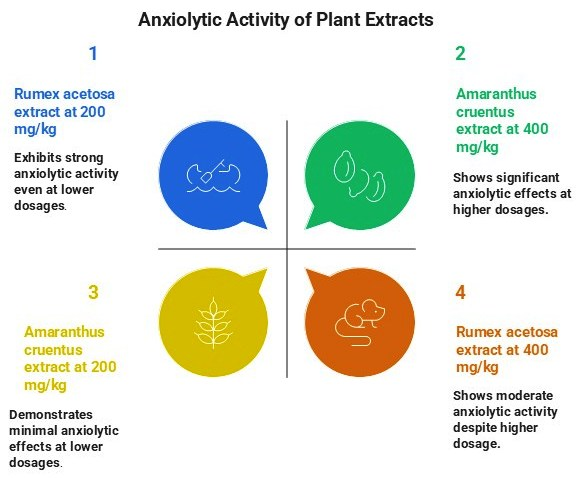
Background: The current study aims to define the anti-anxiety properties of the leaves of Amaranthus cruentus Linn. and Rumex acetosa Linn. Methodology: Soxhlet extraction was used to extract the leaves of Rumex acetosa Linn and Amaranthus cruentus Linn. FTIR and GC-MS were used to investigate the fraction. The elevated plus maze test (EMPT) was used to assess the antianxiety property of methanolic extracts at 200 mg/kg and 400 mg/kg in Swiss albino mice. Results and discussion: Alkaloids, steroids, glycosides, amino acid flavonoids, carbohydrates, and phenolic tannins are found in both extracts. The percentage yields of petroleum ether, chloroform, and methanol extracts were 2.4%, 3.6%, and 10% for Amaranthus cruentus, and 2.1%, 3.2%, and 8% for Rumex acetosa, respectively. Amaranthus cruentus extracts were associated with significant increases (P < 0.05) in the amount of time and the number of entries in open arms. Open arm entries (p < 0.01) and time spent in the open arm (p < 0.01) were both increased by 200 mg/kg of Rumex acetosa Linn extract, while 400 mg/kg increased both of these variables (p < 0.001). Nevertheless, activity rises in tandem with the dosage of Rumex acetosa Linn extract. In EMPT, diazepam (2 mg/kg) significantly increased open arm entries (22.67) and time spent in open arms (3.273 min), while decreasing closed arm entries (6.33) and time spent in closed arms (1.582 min) compared to the control group, confirming its potent anxiolytic activity. Conclusion: The methanolic extracts of both plants exhibit significant anxiolytic properties.
Downloads

References
Thibaut F. Gender does matter in clinical research. Eur Arch Psychiatry Clin Neurosci 267(4), 283–284 (2017) https://doi.org/10.1007/s00406-017-0797-7
Campanelli G, Francois E, Parupathi P, Devarakonda LS, Yang C, Kumar A, et al. The therapeutic efficacy and mechanism of action of gnetin C, a natural compound from the melinjo plant, in a preclinical mouse model of advanced prostate cancer. Cancers 16(7), 1344 (2024) https://doi.org/10.3390/cancers16071344
Garakani A, Murrough JW, Freire RC, Thom RP, Larkin K, Buono FD, et al. Pharmacotherapy of anxiety disorders: current and emerging treatment options. Front Psychiatry 11, 595584 (2020) https://doi.org/10.3389/fpsyt.2020.595584
Parupathi P, Campanelli G, DeAbel RA, Puar A, Devarakonda LS, Kumar A, et al. Gnetin C intercepts MTA1-associated neoplastic progression in prostate cancer. Cancers 14(24), 6038 (2022) https://doi.org/10.3390/cancers14246038
Panossian A, Gabrielian E. On the mechanism of action of plant adaptogens with particular reference to cucurbitacin R diglucoside. Phytomedicine 6(3), 147–155 (1999) https://doi.org/10.1016/S0944-7113(99)80002-6
Popoola JO, Aremu AO. Phenolic compounds composition and in vitro antioxidant activity of Nigerian Amaranthus viridis seed as affected by autoclaving and germination. Meas Food 6, 100028 (2022) https://doi.org/10.1016/j.meafoo.2022.100028
Park YJ, Nemoto K. A rapid and reliable PCR-restriction fragment length polymorphism marker for identification of Amaranthus cruentus species. Breed Sci 64(4), 422–426 (2014) https://doi.org/10.1270/jsbbs.64.422
Adegbola PI, Adetutu A. Antioxidant activity of Amaranthus species from the Amaranthaceae family — A review. S Afr J Bot 133, 111–117 (2020) https://doi.org/10.1016/j.sajb.2020.07.003
Lucero A, Nair MG, McCallum J. Antioxidant properties of Amaranthus hypochondriacus seeds and their effect on the liver of alcohol-treated rats. Plant Foods Hum Nutr 66, 157–162 (2011) https://doi.org/10.1007/s11130-011-0218-4
Mahomoodally MF, Gurib-Fakim A. Antimicrobial activities and phytochemical profiles of endemic medicinal plants of Mauritius. Pharm Biol 43(3), 237–242 (2005) https://doi.org/10.1080/13880200590928825
Howard MB, Villamil MB. Amaranth as a natural food colorant source: survey of germplasm and optimisation of extraction methods for betalain pigments. Front Plant Sci 13, 932440 (2022) https://doi.org/10.3389/fpls.2022.932440
Olusanya NR, Kolanisi U. Underutilization versus nutritional-nutraceutical potential of the Amaranthus food plant: A mini-review. Appl Sci 11(15), 6879 (2021) https://doi.org/10.3390/app11156879
Wolosik K, Markowska A. Amaranthus cruentus: taxonomy, botanical description, and review of its seed chemical composition. Nat Prod Commun 14(5), 1–7 (2019) https://doi.org/10.1177/1934578X19844141
Silva-Sánchez C, Barba de la Rosa AP. Bioactive peptides in Amaranthus hypochondriacus seed. J Agric Food Chem 56(4), 1233–1240 (2008) https://doi.org/10.1021/jf072911
Maldonado-Cervantes E, Jeong HJ. Amaranth lunasin-like peptide internalizes into the cell nucleus and inhibits chemical carcinogen-induced transformation of NIH-3T3 cells. Peptides 31(9), 1635–1642 (2010) https://doi.org/10.1016/j.peptides.2010.06.014
Khare CP. Indian Medicinal Plants: An Illustrated Dictionary. Springer, New Delhi, p. 562 (2007)
Kato T, Morita Y. C-glycosyl flavones with acetyl substitution from Rumex acetosa L. Chem Pharm Bull 38, 2277–2280 (1990) https://doi.org/10.1248/cpb.38.2277
Bello OM, Fasinu PS, Bello OE, Ogbesejana AB, Adetunji CO, Dada AO, et al. Wild vegetable Rumex acetosa Linn.: Its ethnobotany, pharmacology and phytochemistry — A review. S Afr J Bot 125, 149–160 (2019) https://doi.org/10.1016/j.sajb.2019.07.015
Lee NJ, Choi JH, Koo BS. Antimutagenicity and cytotoxicity of constituents from aerial parts of Rumex acetosa. Biol Pharm Bull 28, 2158–2161 (2005) https://doi.org/10.1248/bpb.28.2158
Gescher K, Hensel A, Hafezi W. Oligomeric proanthocyanidins from Rumex acetosa inhibit attachment of herpes simplex virus type-1. Antiviral Res 89, 9–18 (2011) https://doi.org/10.1016/j.antiviral.2010.10.007
Wegiera M, Kosikowska U, Malm A. Antimicrobial activity of extracts from fruits of Rumex species. Cent Eur J Biol 6, 1036–1043 (2011) https://doi.org/10.2478/s11535-011-0066-0
Duke JA, Godwin MJB, duCellier J, Duke PK. Handbook of Medicinal Herbs. 2nd ed., CRC Press, New York, pp. 683–684 (2002)
Li JJ, Li YX, Li N, Zhu HT, Wang D, Zhang YJ. The genus Rumex (Polygonaceae): an ethnobotanical, phytochemical and pharmacological review. Nat Prod Bioprospect 12, 21 (2022) https://doi.org/10.1007/s13659-022-00338-y
Nagori M, Rajput D, Choudhary G, Khabiya R. Qualitative and quantitative methods of phytochemical analysis. In: Pharmacognosy and Phytochemistry: Principles, Techniques, and Clinical Applications. pp. 143–166 (2025) https://doi.org/10.1002/9781119905777.ch8
Shahed-Al-Mahmud M, Lina SMM. Evaluation of sedative and anxiolytic activities of methanol extract of leaves of Persicaria hydropiper in mice. Clin Phytosci 3, 20 (2017) https://doi.org/10.1186/s40816-017-0056-5
Mazumder K, Sumi TS, Golder M, Biswas B, Kerr PG. Antidiabetic profiling, cytotoxicity and acute toxicity evaluation of aerial parts of Phragmites karka (Retz.). J Ethnopharmacol 270, 113781 (2021) https://doi.org/10.1016/j.jep.2021.113781
Silva Oliveira GL, Oliveira CKB, Santos LCRS, Benedito RB, Sousa DP, Almeida RN, et al. Anticonvulsant, anxiolytic and antidepressant properties of β-caryophyllene in Swiss mice: involvement of benzodiazepine-GABAergic, serotonergic and nitrergic systems. Curr Mol Pharmacol 14(1), 36–51 (2021) https://doi.org/10.2174/1874467213666200510004622
Nana FW, Hilou A, Millogo JF, Nacoulma OG. Phytochemical composition, antioxidant and xanthine oxidase inhibitory activities of Amaranthus cruentus L. and A. hybridus L. extracts. Pharmaceuticals 5, 613–628 (2012) https://doi.org/10.3390/ph5060613
Li JJ, Li YX, Li N, Zhu HT, Wang D, Zhang YJ. The genus Rumex (Polygonaceae): an ethnobotanical, phytochemical and pharmacological review. Nat Prod Bioprospect 12, 46 (2022) https://doi.org/10.1007/s13659-022-00346-z
Sharma C, Al Kaabi JM. Polypharmacological properties and therapeutic potential of β-caryophyllene: a dietary phytocannabinoid. Curr Pharm Des 22(21), 3237–3264 (2016) https://doi.org/10.2174/1381612822666160311115226
Ashton CH, Moore PB. Endocannabinoid system dysfunction in mood and related disorders. Acta Psychiatr Scand 124, 250–261 (2011) https://doi.org/10.1111/j.1600-0447.2011.01687.x
Onaivi ES. Cannabinoid receptors in brain: pharmacogenetics, neuropharmacology and therapeutic applications. Int Rev Neurobiol 88, 335–369 (2009) https://doi.org/10.1016/S0074-7742(09)88012-4
Riebe CJ, Wotjak CT. Endocannabinoids and stress. Stress 14, 384–397 (2011) https://doi.org/10.3109/10253890.2011.586753
Bouaboula M, Poinot-Chazel C, Bourrie B, Canat X, Calandra B, Rinaldi-Carmona M, et al. Signalling pathway associated with stimulation of CB2 peripheral cannabinoid receptor: involvement of MAP kinase and induction of Krox-24 expression. Eur J Biochem 237, 704–711 (1996) https://doi.org/10.1111/j.1432-1033.1996.0704p.x
Van Sickle MD, Duncan M, Kingsley PJ, Mouihate A, Urbani P, Mackie K, et al. Identification and functional characterization of brainstem cannabinoid CB2 receptors. Science 310, 329–332 (2005) https://doi.org/10.1126/science.1115740
Marco EM, Garcia-Gutierrez MS. Endocannabinoid system and psychiatry: neurobiological basis of therapeutic effects. Front Behav Neurosci 5, 63 (2011) https://doi.org/10.3389/fnbeh.2011.00063
Turcotte C, Blanchet MR, Laviolette M, Flamand N. The CB2 receptor and its role as a regulator of inflammation. Cell Mol Life Sci 73, 4449–4470 (2016) https://doi.org/10.1007/s00018-016-2300-4
Karim N, Irshad S, Khan I, Ahmad N, Waheed A, Abdel-Halim H, et al. GABA(A) receptor modulation and neuropharmacological activities of viscosine isolated from Dodonaea viscosa (Linn). Pharmacol Biochem Behav 136, 64–72 (2015) https://doi.org/10.1016/j.pbb.2015.07.006
Abdelhalim A, Karim N, Chebib M, Aburjai T, Khan I, Johnston GAR, et al. Anxiolytic and antinociceptive activities of constituents from Rosmarinus officinalis. J Pharm Pharm Sci 18(4), 448–459 (2015) https://doi.org/10.18433/J3PW38
Andrade JC, Monteiro ÁB, Andrade HH, Gonzaga TK, Silva PR, Alves DN, et al. Involvement of GABA(A) receptors in the anxiolytic-like effect of hydroxycitronellal. Biomed Res Int 2021, 9929805 (2021) https://doi.org/10.1155/2021/9929805
Kothari S, Gupta A. Experimental evaluation of anxiolytic and antidepressant activities of methanolic extract of Triticum aestivum (wheatgrass) in albino mice. Journal of Applied Pharmaceutical Research 11(3), 41–47 (2023) https://doi.org/10.18231/j.joapr.2023.11.3.41.47
Lister RG. Ethologically-based animal models of anxiety disorders. Pharmacol Ther 46, 321–340 (1990) https://doi.org/10.1016/0163-7258(90)90021-S
Pandey S, Ganeshpurkar A, Bansal D, Dubey N. Hematopoietic effect of Amaranthus cruentus extract on phenylhydrazine-induced toxicity in rats. J Diet Suppl 13, 1–9 (2016) https://doi.org/10.3109/19390211.2016.1155685
Published
How to Cite
Issue
Section
Copyright (c) 2026 Chitra Govind Rajput, Sachinkumar Vasantarao Patil, Pallavi Abhijeet Patil

This work is licensed under a Creative Commons Attribution-NonCommercial 4.0 International License.