Simultaneous RP-HPLC quantification of curcumin, silymarin, and piperine: Method development and validation
DOI:
https://doi.org/10.69857/joapr.v14i4.1891Keywords:
Curcumin, Silymarin, Piperine, RP-HPLC, Simultaneous Estimation, Linearity, Sensitivity, Method ValidationAbstract
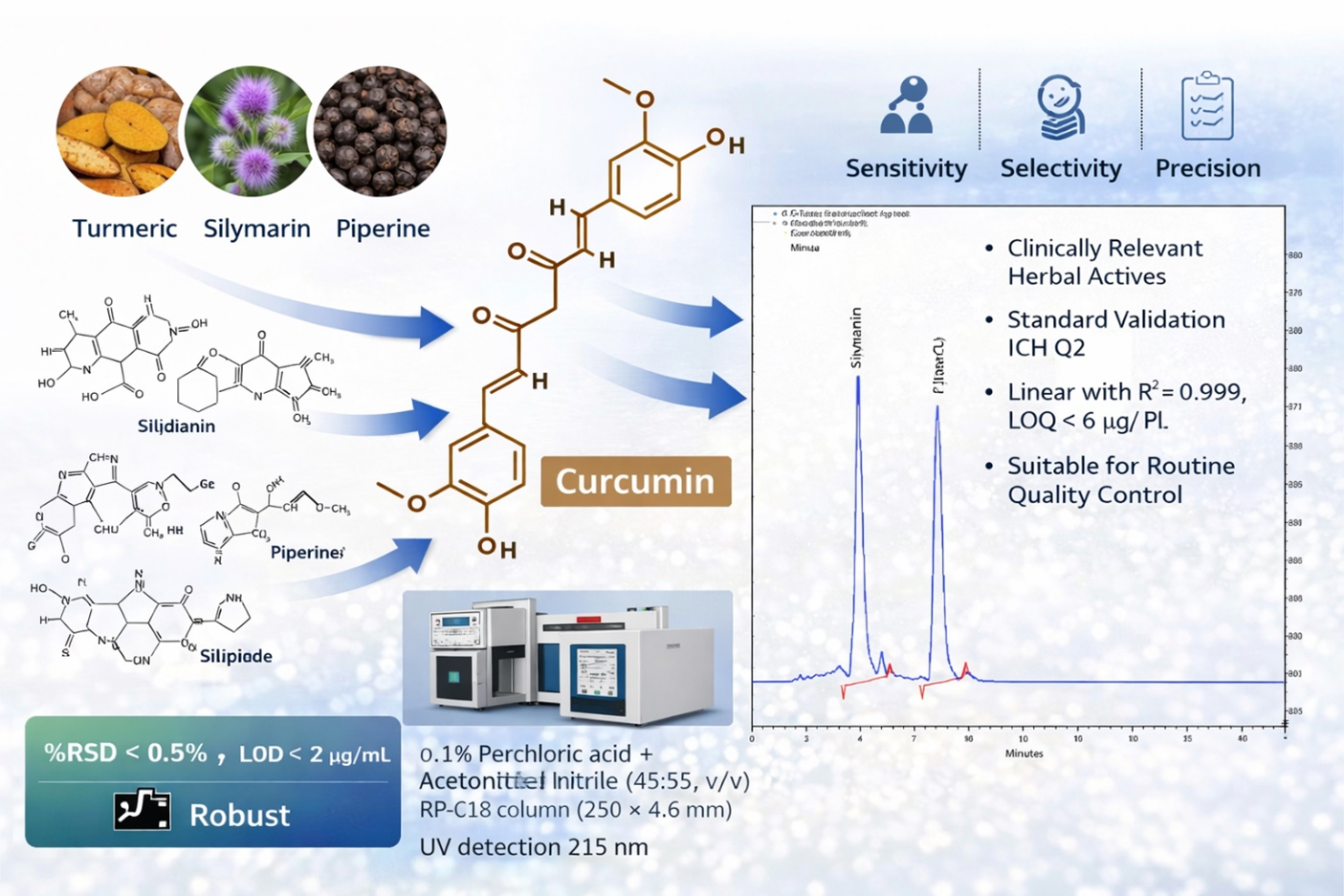
Background: Herbal formulations containing multiple phytoconstituents require analytical methods that can simultaneously determine structurally diverse compounds with adequate selectivity and precision. Curcumin (CUR), Silymarin (SLY), and Piperine (PIP) are widely incorporated into polyherbal preparations owing to their clinically studied pharmacological actions. Ensuring consistent quality of such formulations requires a validated, reliable chromatographic procedure. Methodology: A reverse-phase HPLC method was established for concurrent estimation of CUR, SLY, and PIP using an Agilent Zorbax Bonus RP column (250 × 4.6 mm, 5 μm). Separation was achieved with a mobile phase of 0.1% perchloric acid and acetonitrile (45:55, v/v) at 1.0 mL/min, with UV detection at 215 nm. The method was evaluated for specificity, precision, linearity, accuracy, and sensitivity using standard validation criteria aligned with internationally accepted analytical quality guidelines. Results and Discussion: The analytes were successfully separated within 11 minutes, with retention times of 4.09 min for Silymarin, 7.39 min for Piperine, and 10.25 min for Curcumin. System precision demonstrated %RSD values below 0.21% for all analytes. Recovery values across 80–120% concentration levels were close to 100%, with %RSD <0.5%, reflecting excellent accuracy. Calibration curves exhibited strong linearity (R² = 0.999). The method demonstrated high sensitivity with LOD values below 2 µg/mL and LOQ values below 6 µg/mL for each compound. Both intra-day and inter-day evaluations showed %RSD <0.4%, confirming robust reproducibility. Robustness testing with small, deliberate variations showed %RSD <1.5%, confirming the method's reliability. Conclusion: The developed RP-HPLC protocol offers a selective, reproducible, and sensitive analytical approach suitable for simultaneous quantification of SLY, PIP, and CUR in combined herbal matrices.
Downloads

References
Sayyad M, Sutar AD, Shivhare K, Shukla R, Flora SJS. Silymarin as a phytopharmaceutical agent: advances in mechanistic insights, formulation strategies, and pre-clinical applications. Front Pharmacol, 16, 1711653 (2025) https://doi.org/10.3389/fphar.2025.1711653
Selc M, Babelova A. Looking beyond silybin: the importance of other silymarin constituents in translational research. Front Pharmacol, 16, 1637393 (2025) https://doi.org/10.3389/fphar.2025.1637393
Rizwan M, Naseem S, Durrani AI. Pharmacokinetics and therapeutic potential of milk thistle extracted phytoconstituents: a leading role in cancer treatment. J Adv Immunopharmacol, 3(2), e138889 (2023) https://doi.org/10.5812/tms-138889
Satyam SM, Bairy LK, Rehman A, Nair AA, Farook M, Binu NN, et al. Dapagliflozin and silymarin ameliorate cisplatin-induced nephrotoxicity in female Wistar rats. Sci, 7(2), 59 (2025) https://doi.org/10.3390/sci7020059
Xie Y, Zhang D, Zhang J, Yuan J. Effects of silymarin on drug-metabolizing enzymes and transporters: implications for drug–drug interactions. Molecules, 24(20), 3693 (2019) https://doi.org/10.3390/molecules24203693
Sharma P, Asediya V, Kalra G, Sultana S, Purohit N, Kibitlewska K, et al. Hepatoprotective effect of silymarin herb in prevention and treatment of metabolic-associated steatotic liver disease: current evidence and future prospects. Nutrients, 17(20), 3278 (2025) https://doi.org/10.3390/nu17203278
Periferakis AT, Adalis GM, Periferakis A, Troumpata L, Periferakis K, Dragosloveanu CDM, et al. The multifaceted antimicrobial profile of piperine in infectious disease management: current perspectives and potential. Pharmaceuticals, 18(10), 1581 (2025) https://doi.org/10.3390/ph18101581
Akter K, Gul K, Mumtaz S. Revisiting curcumin in cancer therapy: recent insights into molecular mechanisms, nanoformulations, and synergistic combinations. Curr Issues Mol Biol, 47(9), 716 (2025) https://doi.org/10.3390/cimb47090716
Kotha RR, Luthria DL. Curcumin: biological, pharmaceutical, nutraceutical, and analytical aspects. Molecules, 24(16), 2930 (2019) https://doi.org/10.3390/molecules24162930
Zheng BW, Wang BY, Xiao WL, Sun YJ, Yang C, Zhao BT, et al. Different molecular weight hyaluronic acid alleviates inflammation response in DNFB-induced mice atopic dermatitis and LPS-induced RAW 264.7 cells. Life Sci, 301, 120591 (2022) https://doi.org/10.1016/j.lfs.2022.120591
Jamil SNH, Ali AH, Feroz SR, Lam SD, Agustar HK, Mohd Abd Razak MR, et al. Curcumin and its derivatives as potential antimalarial and anti-inflammatory agents: a review on structure-activity relationship and mechanism of action. Pharmaceuticals (Basel), 16(4), 609 (2023) https://doi.org/10.3390/ph16040609
Kiskova T, Smajda B. The effects of bioactive compounds on human brain structures and diseases. Int J Mol Sci, 25(6), 3326 (2024) https://doi.org/10.3390/ijms25063326
Joshi P, Bisht A, Paliwal A, Dwivedi J, Sharma S. Recent updates on clinical developments of curcumin and its derivatives. Phytother Res, 37(11), 5109–5158 (2023) https://doi.org/10.1002/ptr.7974
Babich O, Larina V, Ivanova S, Tarasov A, Povydysh M, Orlova A, et al. Phytotherapeutic approaches to the prevention of age-related changes and the extension of active longevity. Molecules, 27(7), 2276 (2022) https://doi.org/10.3390/molecules27072276
Wilar G, Suhandi C, Fukunaga K, Shigeno M, Kawahata I, Abdulah R, et al. Effects of nanocurcumin supplementation on metabolic syndrome: a systematic review and meta-analysis of randomized controlled trials. Pharmacol Res, 213, 107641 (2025) https://doi.org/10.1016/j.phrs.2025.107641
Wang Z, Jones G, Winzenberg T, Cai G, Laslett LL, Aitken D, et al. Effectiveness of Curcuma longa extract for the treatment of symptoms and effusion–synovitis of knee osteoarthritis: a randomized trial. Ann Intern Med, 173(11), 861–869 (2020) https://doi.org/10.7326/M20-0990
Dowgiałło-Gornowicz N, Masiewicz A, Kacperczyk J, Lech P, Saluk S, Osowiecka K. Long-term outcomes of chronic cough reduction after laparoscopic Nissen fundoplication — a single-center study. Medicina, 58(1), 47 (2022) https://doi.org/10.3390/medicina58010047
Miserocchi E, Giuffrè C, Cicinelli MV, Marchese A, Gattinara M, Modorati G, et al. Oral phospholipidic curcumin in juvenile idiopathic arthritis-associated uveitis. Eur J Ophthalmol, 30(6), 1390–1396 (2020) https://doi.org/10.1177/1120672119892804
Lastra JM, Curieses Andrés CM, Munguira EB, Juan CA, Pérez Lebeña E. Silymarin as a redox-signalling and proteostasis modulator. Neutraceu, 6(2), 25 (2026) https://doi.org/10.3390/nutraceuticals6020025
Wu M, Xiong Y, Zhu L, ZeWeng YZ, Li R, Zhang J, et al. A comprehensive method for quality evaluation of Tibetan medicine Synotis solidaginea by integrating UHPLC-Q-Orbitrap MS chemical profiling and UHPLC-DAD multi-components quantification. J Pharm Biomed Anal, 240, 115983 (2024) https://doi.org/10.1016/j.jpba.2024.115983
Petrásková L, Káňová K, Biedermann D, Křen V, Valentová K. Simple and rapid HPLC separation and quantification of flavonoids and flavonolignans in silymarin. Foods, 9(2), 116 (2020) https://doi.org/10.3390/foods9020116
Amber B, Ravindra MK, Christine J. HPLC method development and validation for the quantification of related impurities in testosterone cypionate active pharmaceutical ingredient. Indian J Pharm Educ Res, 56(1), 240–246 (2022) https://doi.org/10.5530/ijper.56.1.28
Ha ES, Han DG, Seo SW, Kim JM, Lee SK, Sim WY, et al. A simple HPLC method for the quantitative determination of silybin in rat plasma: application to a comparative pharmacokinetic study on commercial silymarin products. Molecules, 24(11), 2180 (2019) https://doi.org/10.3390/molecules24112180
Kagawad P, Gharge S, Jivaje K. Quality control and standardization of quercetin in herbal medicines by spectroscopic and chromatographic techniques. Futur J Pharm Sci, 7, 176 (2021) https://doi.org/10.1186/s43094-021-00327-y
Parab GV, Mannur VK, Hullatti K. Quality assessment and analytical quality by design-based RP-HPLC method development for quantification of piperine in Piper nigrum L. Futur J Pharm Sci, 8, 16 (2022) https://doi.org/10.1186/s43094-022-00405-9
Chaudhari VS, Borkar RM, Murty US, Banerjee S. Analytical method development and validation of reverse-phase high-performance liquid chromatography (RP-HPLC) method for simultaneous quantifications of quercetin and piperine in dual-drug loaded nanostructured lipid carriers. J Pharm Biomed Anal, 186, 113325 (2020) https://doi.org/10.1016/j.jpba.2020.113325
Setyaningsih D, Santoso YA, Hartini YS, Murti YB. Isocratic HPLC for simultaneous quantification of curcumin and piperine in a microparticle formulation containing Curcuma longa and Piper nigrum. Heliyon, 7(3), e06541 (2021) https://doi.org/10.1016/j.heliyon.2021.e06541
Rodriguez EL, Zhang C, Woolfork AG, Li Z, Bi C, Kaur H, et al. Analysis of curcumin and piperine in biological samples by reversed-phase liquid chromatography with multi-wavelength detection. J Chromatogr B, 1162, 122487 (2021) https://doi.org/10.1016/j.jchromb.2020.122487
Marcon MV, Schafka VM, Justus B, Nadal JM, Schnekenberg CM, Shirabayashi JB, et al. Co-quantification of curcuminoids and piperine by RP-HPLC/DAD from spray-dried microparticles for routine quality control. Braz Arch Biol Technol, 68, e25240301 (2025) https://doi.org/10.1590/1678-4324-2025250760
Noshadi B, Burgaz V, Pozharani LB. Development and validation of an RP-HPLC method for the simultaneous quantification of metformin and curcumin. Cyp J Med Sci, 10(1), 4–7 (2025) https://doi.org/10.4274/cjms.2024.2024-132
Desai NE, Momin M, Singh UP, Khan TA, Sherje A. Analytical method development and validation for simultaneous estimation of curcumin and cyclosporine by RP-HPLC. Int J Pharm Pharm Sci, 11(2), 26–33 (2019) https://doi.org/10.22159/ijpps.2019v11i2.28975
Published
How to Cite
Issue
Section
Copyright (c) 2026 Misbah Sultana Abdul Kausar Badewale, Varsha Siddheshwar Tegeli

This work is licensed under a Creative Commons Attribution-NonCommercial 4.0 International License.