Phytochemical screening, antioxidant activity and GC-MS analysis of Syzygium diospyrifolium (Wall.Ex Duthie) S.N. Mitra: A medicinal plant from Meghalaya, India
DOI:
https://doi.org/10.69857/joapr.v13i5.1565Keywords:
Syzygium diospyrifolium (Wall.ex Duthie) S.N. Mitra, Phytochemical analysis, antioxidant activity, GC-MS, nutraceutical, methanol extractAbstract
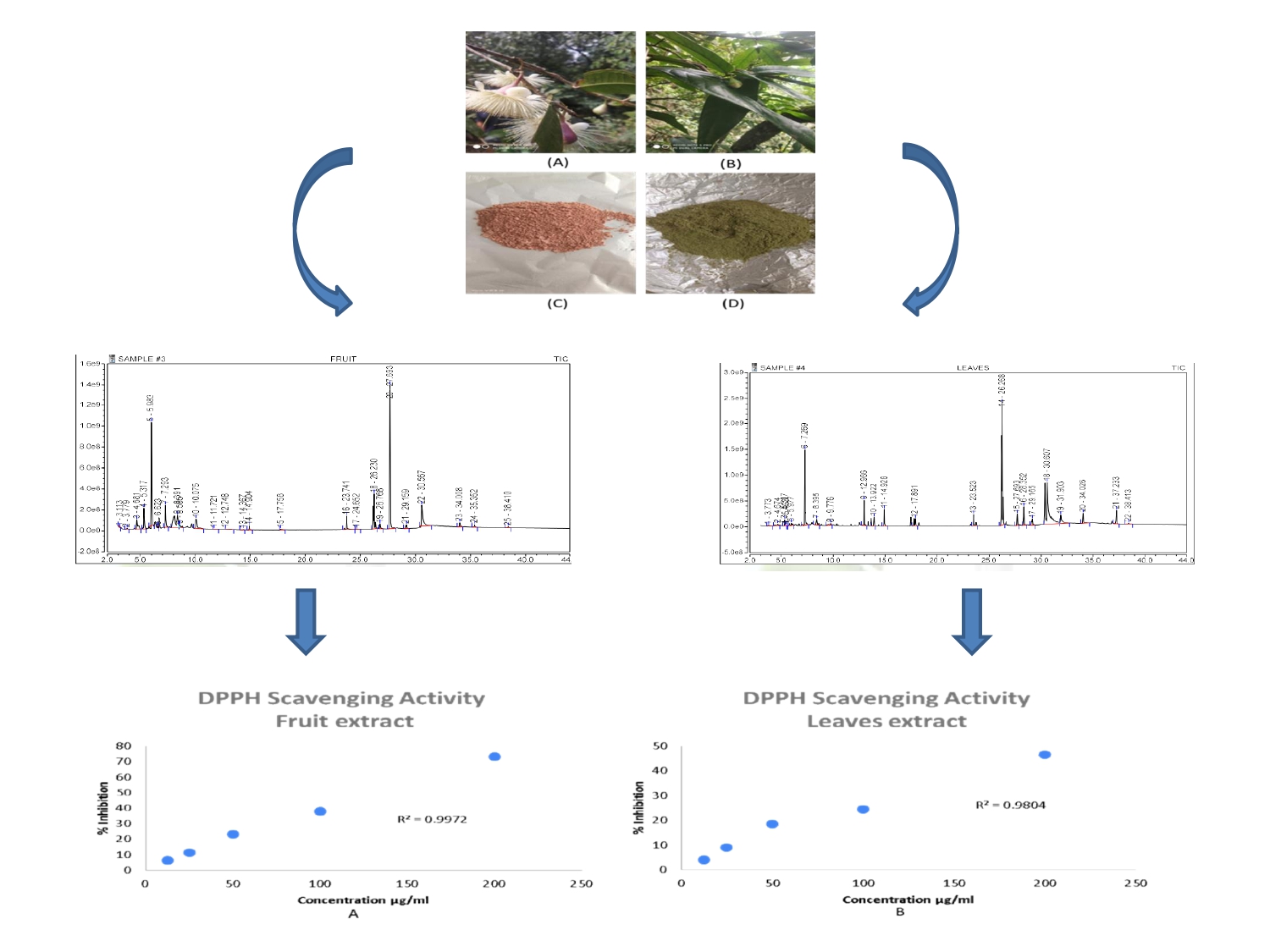
Background: Syzygium diospyrifolium (Wall.ex Duthie) S.N. Mitra is a traditionally valued but underexplored medicinal plant from Meghalaya, India. This study aimed to assess the phytochemical composition, antioxidant potential, and GC–MS profile of its fruit and leaf extracts to explore their therapeutic prospects. Methods: Methanol and ethanol extracts of the fruits and leaves were prepared using a Soxhlet extraction apparatus. Percentage yields were determined, and qualitative phytochemical screening identified secondary metabolites. Total phenolic content (TPC) and total flavonoid content (TFC) were quantified spectrophotometrically, while antioxidant activity was evaluated using DPPH radical scavenging and reducing power assays. GC–MS analysis identified bioactive compounds. All experiments were performed in triplicate (n=3), and results were expressed as mean ± SD with significance at p < 0.05 (Student’s t-test). Results: Methanol extracts yielded higher percentages (fruit: 15.2% w/w; leaf: 14.4% w/w) than ethanol extracts. Both extracts contained alkaloids, glycosides, saponins, phenols, tannins, flavonoids, proteins, amino acids, and diterpenes. Fruits exhibited higher TPC (52.23 mg GAE/g) and TFC (152 mg QE/g) than leaves (26.96 mg GAE/g; 96.86 mg QE/g; p < 0.05). Antioxidant assays showed stronger activity in fruits (DPPH IC₅₀: 133.95 µg/mL) than leaves (215.11 µg/mL). GC–MS analysis identified sugars, fatty acid amides, sterols, terpenoids, and phenolic derivatives, including DL-Arabinose, D-Allose, and 13-Docosenamide (Z), reported for the first time. Conclusion: This first GC-MS-based phytochemical profiling of S. diospyrifolium (Wall.ex Duthie) S.N. Mitra reveals its fruits as rich in phenolic and flavonoid compounds with significant antioxidant potential, supporting its promise for nutraceutical and phytopharmaceutical applications
Downloads

References
Devi RS, Bihari SK, Kumar S. Validation of tribal claims for formulation of future drugs through evaluation of ethno-pharmacological values of Ludwigia adscendens. Afr J Biol Sci, 6(Suppl4), 2024, 6134–6141. https://doi.org/10.48047/AFJBS.6.Si4.2024.6134-6141
Singh NP, Singh KP, Singh DK. Flora of Mizoram, 3rd ed. Kolkata: Botanical Survey of India, 2024
Shareef SM. Syzygium syzygioides (Myrtaceae), a new distributional record for Peninsular India. Journal of the Indian Association for Angiosperm Taxonomy, 30(2), 307 – 311 (2020) https://dx.doi.org/10.22244/rheedea.2020.30.02.08
Dey D, Sarma J, Devi N. Syzygium namborense (Myrtaceae), a new species from Assam, India. Phytotaxa, 538(2), 2022, 133–140. https://doi.org/10.11646/phytotaxa.538.2.5
Dey D, Baruah M, Kalita S, Paul M, Kalita B, Devi N. Taxonomic review of Syzygium polypetalum (Wall.) Merr. & L.M. Perry (Myrtaceae) - a lesser known chasmophytic jambolan species of Assam. Plant Sci. Today, 9, 25–8 (2022) https://doi.org/10.14719/pst.1624.
Kumar M, Hasan M, Lorenzo JM, Dhumal S, Nishad J, Rais N, et al. Jamun (Syzygium cumini (L.) Skeels) seed bioactives and its biological activities: a review. Food Biosci, 50(B), 2022, 102109. https://doi.org/10.1016/j.fbio.2022.102109
Idris NS, Khandaker MM, Rashid ZM, Majrashi A, Alenazi MM, Nor ZM, et al. Polyphenolic compounds and biological activities of leaves and fruits of Syzygium marangense cv. ‘Giant Green’ at three different maturities. Horticulturae, 9(3), 2023, 326. https://doi.org/10.3390/horticulturae9030326
Jahan FI, Anik AH, Akter S. Exploring the Therapeutic Potential of Eleusine Indica Plant: Promising Antioxidant and Analgesic Activity With Lack of Antimicrobial and Thrombolytic Activity. J. Appl. Pharm. Res., 13, 86–94 (2025) https://doi.org/10.69857/joapr.v13i2.688.
Devi R, Singh S, Moond M, Beniwal R, Kumar S, Kumari S, et al. Proximate composition, phenolic-flavonoid content and antioxidant potential of Syzygium cumini (L.) Skeels seed powder. Ann Phytomed, 12(1), 2023, 508–513 http://dx.doi.org/10.54085/ap.2023.12.1.23
Sharma S, Bhuyan NR, Mohanty JP. A pharmacognostic, phytochemical, and antioxidant potential of Oxalis triangularis. J. Appl. Pharm. Res., 12, 133–45 (2024) https://doi.org/10.69857/joapr.v12i5.701.
Dahiya S, Garg M. Investigating phytochemical diversity and antioxidant richness of Moringa oleifera in Tamil Nadu. J. Appl. Pharm. Res., 12, 203–14 (2024) https://doi.org/10.69857/joapr.v12i6.710
Olu Kayode OO, Onocha PA, Oloyede GK, Aoyerokun D, Ibok MG, Okpala EO. Antimicrobial and antioxidant activities of sesquiterpene-rich essential oil of Trichilia monadelha (Thonn.) J.J. De Wilde root bark. Biol Med Nat Prod Chem, 12(2), 2023, xx–yy https://doi.org/10.14421/biomedich.2023.122.687-692
Biradar S, Kulkarni AD, Habbu PV, et al. Phytochemical procedure. Adv Pharmacol Pharm Sci, 2022, 1998808. https://doi.org/10.1155/2022/1998808
Senapati M, Dehuri M, Mohanty B, Sahoo G. Phytochemical screening and anthelmintic efficacy of Punica granatum peels and Moringa oleifera leaves against Haemonchus contortus. J Parasit Dis, XX(XX), 2025, 82–93 https://doi.org/10.1007/s12639-025-01822-2
Birundadevi M. Antioxidant and antibacterial activity of polyphenol-rich fraction from leaves of Ocimum gratissimum. Int J Bot Stud, 6(6), 2021, 575–579
Sinan KI, Cadiz-Gurrea ML, Leyva-Jimenez FJ, Fernandez-Ochoa A, Sokovic M, Nenadic M, et al. UPHLC-ESI-QTOF/MS profiling and antioxidant activity of methanol extract of Phyllanthus reticulatus leaves and stem bark. New J Chem, 45(48), 2021, 22968–22979. http://doi.org/10.1039/D1NJ03621A
Rumpf J, Burger R, Schulze M. Statistical evaluation of DPPH, ABTS, FRAP, and Folin-Ciocalteu assays to assess the antioxidant capacity of lignins. Int J Biol Macromol, 233, 2023, 123470 https://doi.org/10.1016/j.ijbiomac.2023.123470
Wathsara HPT, Weeratunge HD, Mubarak MNA, Godakumbura PI, Ranasinghe P. In vitro antioxidant and antidiabetic potentials of Syzygium caryophyllatum L. Alston. Evid Based Complement Alternat Med, 2020, 9529042. https://doi.org/10.1155/2020/9529042
Nazir N, Zahoor M, Uddin F, Nisar M. Chemical composition, in vitro antioxidant, anticholinesterase, and antidiabetic potential of essential oil of Elaeagnus umbellate Thunb. BMC Complement Med Ther, 21(1), 2021, 73. https://doi.org/10.1186/s12906-021-03228-y
Huang ZR, Lin YK, Fang JY. Biological and pharmacological activities of squalene and related compounds: potential uses in cosmetic dermatology. Molecules, 14(1), 2009, 540–554. https://doi.org/10.3390/molecules14010540
Tucker JM, Townsend DM. Alpha-tocopherol: roles in prevention and therapy of human disease. Biomed Pharmacother, 59(7), 2005, 380–387. https://doi.org/10.1016/j.biopha.2005.06.005
Zhang P, Liu N, Xue M, Zhang M, Liu W, Xu C, et al. Anti-inflammatory and antioxidant properties of β-sitosterol in copper sulfate-induced inflammation in zebrafish (Danio rerio). Antioxidants (Basel), 12(2), 2023, 391. https://doi.org/10.3390/antiox12020391
Singh SK, Shrivastava S, Mishra AK, Kumar D, Pandey VK, Srivastava P, et al. Friedelin: structure, biosynthesis, extraction, and its potential health impact. Molecules, 28(23), 2023, 7760. https://doi.org/10.3390/molecules28237760
Dutta A, Panchali T, Khatun A, Jarapala SR, Das K, Ghosh K, et al. Anti-cancer potentiality of linoelaidic acid isolated from marine Tapra fish oil (Ophisthopterus tardoore) via ROS generation and caspase activation on MCF-7 cell line. Sci Rep, 13, 2023, 34885. https://doi.org/10.1038/s41598-023-34885-3
Zhou Q, Wu Z, Cheng X, Zuo Z, Fan C. Exploring melezitose as a potential therapeutic agent in lung cancer: Inhibitory effects on cell proliferation and EMT-mediated signaling in A549 cells. Pharma Med, 1(1), 2024, 1–9. https://doi.org/10.1177/09731296241251545
Tang X, Ravikumar Y, Zhang G, Yun J, Zhao M, Qi X. D-allose, a typical rare sugar: Properties, applications, and biosynthetic advances and challenges. Crit Rev Food Sci Nutr, 20, 2024, 1–28. https://doi.org/10.1080/10408398.2024.2350617
Chen Z, Xi G, Fu Y, Wang Q, Cai L, Zhao Z, Liu Q, Bai B, Ma Y. Synthesis of 2,3-dihydro-3,5-dihydroxy-6-methyl-4H-pyran-4-one from maltol and its taste identification. Food Chem, 361, 2021, 130052. https://doi.org/10.1016/j.foodchem.2021.130052
Hanif MU, Hussain AI, Aslam N, Kamal GM, Chatha SAS, Shahida S, Khalid M, Hussain R. Chemical Composition and Bioactivities of Essential Oil from Leaves of Syzygium cumini (L.) Skeels Native to Punjab, Pakistan. Chemistry & Biodiversity, 17, (2020) https://doi.org/10.1002/cbdv.201900733.
El-Nashar HAS, Eldehna WM, Al-Rashood ST, Alharbi A, Eskandrani RO, Aly SH. GC/MS Analysis of Essential Oil and Enzyme Inhibitory Activities of Syzygium cumini (Pamposia) Grown in Egypt: Chemical Characterization and Molecular Docking Studies. Molecules, 26, 6984 (2021) https://doi.org/10.3390/molecules26226984.
Parimala SM, Salomi AA. GC-MS Analysis and Antimicrobial Assessment of Syzygium cumini (L.) Skeels Seed Ethanol Extract. JPRI, 271–83 (2021) https://doi.org/10.9734/jpri/2021/v33i56b33953.
El-Nashar HAS, Eldehna WM, Al-Rashood ST, Alharbi A, Eskandrani RO, Aly SH. GC/MS analysis of essential oil and enzyme inhibitory activities of Syzygium cumini (Pamposia) grown in Egypt: Chemical characterization and molecular docking studies. Molecules, 26(22), 2021 https://doi.org/10.3390/molecules26226984
Halim MA, Kanan KA, Nahar T, Rahman MJ, Ahmed KS, Hossain H, Mozumder NHMR, Ahmed M. Metabolic profiling of phenolics of the extracts from the various parts of blackberry plant (Syzygium cumini L.) and their antioxidant activities. LWT, 167, 113813 (2022) https://doi.org/10.1016/j.lwt.2022.113813.
Valarezo E, Ledesma-Monteros G, Jaramillo-Fierro X, Radice M, Meneses MA. Antioxidant Application of Clove (Syzygium polyanthum) Essential Oil in Meat and Meat Products: A Systematic Review. Plants, 14, 1958 (2025) https://doi.org/10.3390/plants14131958.
Ramadhan R, Lestari DA, Phuwapraisirisan P, Firdaus YFH, Kurnia IT, Hariyanto IT, Suhartini S, Abdulgani N, Fariha NM, Phontree K, Saibun S, Pratiwi DR. Phytochemicals, Antidiabetic, and Antioxidant Activities of Syzygium polyanthum Achieved by GC-MS Analysis, α-Glucosidase Inhibition and Kinetic Mechanism along with a Free Radicals Scavenging Activities. Moroccan Journal of Chemistry, 13(1), 34 – 56 (2024) https://doi.org/10.48317/IMIST.PRSM/MORJCHEM-V13I1.45267.
Mahdi I, Imbimbo P, Ortaakarsu AB, Adhiambo Ochieng M, Ben Bakrim W, Drissi BE, Ibrahim MA, Abdelfattah MAO, Mahmoud MF, Monti DM, Sobeh M. Chemical profiling and dermatological and anti-aging properties of Syzygium jambos L. (Alston): evidence from molecular docking, molecular dynamics, and in vitro experiments. Front. Mol. Biosci., 10, (2024) https://doi.org/10.3389/fmolb.2023.1331059.
Published
How to Cite
Issue
Section
Copyright (c) 2025 Amaryllis Langbang, Manas Jyoti Kapil, Neelakshi Sharma, Jayashree Majumdar, Probin Phanjom

This work is licensed under a Creative Commons Attribution-NonCommercial 4.0 International License.