Pharmacognostic, in vitro antioxidant and hepatoprotective activity of leaves of garden croton, Codiaeum variegatum (Euphorbiaceae)
DOI:
https://doi.org/10.69857/joapr.v13i5.1561Keywords:
Antioxidant, Garden croton, Phenolic compound, oxidative stress, hepatoprotective activityAbstract
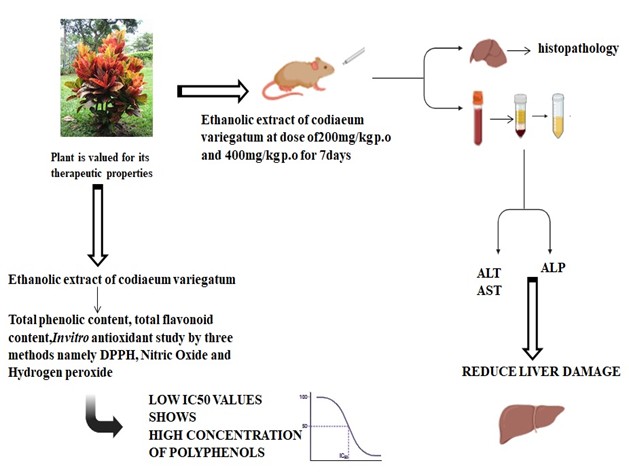
Background: Commonly referred to as garden croton, Codiaeum variegatum is a tropical decorative plant that is valued for both its therapeutic properties and its colourful foliage. The present study investigates the antioxidant and hepatoprotective properties of garden croton. Methodology: The phytochemical screening was conducted to determine the amount of polyphenols present in the sample. The Total Phenolic and flavonoid content was performed by the Folin and Aluminium chloride method, respectively. Furthermore, the samples were evaluated using various antioxidant methods. Hepatoprotective activities of the crude extract of the plant were carried out based on paracetamol-induced liver damage in mice. Serum biomarkers (AST, ALT, ALP, and hepatotoxicity index) were assessed to determine the effect. Histopathological examination was also performed on all groups of mice to further confirm the findings. Result and Discussion: The different methods revealed that the antioxidant potential increased with higher concentrations of polyphenols in the sample. The IC₅₀ values ranged from 99.28 to 115.22 µg/mL with three different methods. Pre-treatment of the mice with the crude extract of Croton significantly reduced ALP (p < 0.05), ALT (p < 0.05), and AST (p < 0.05) levels at all administered doses compared to the toxic group. Conclusion: Croton leaves may serve as a natural source of novel compounds with hepatoprotective properties. These results suggest that Ornamental plants also contain a higher concentration of bioactive compounds capable of neutralizing free radicals and show hepatoprotective activity at very low doses. However, further research is recommended to isolate and characterize the specific phytoconstituents responsible for the activity and to elucidate their mechanisms of action in greater detail.
Downloads

References
Dauda WP, Dantata IJ, Adetunji CO, Abraham P, Ifeanyi UJ, Glen E, et al. The effect of evaporative coolant structure on ornamental plants. In Evaporative Coolers for the Postharvest Management of Fruits and Vegetables. Academic Press, 209–235 (2023) https://doi.org/10.1016/B978-0-323-89864-5.00011-4
Njoya EM, Fewou PM, Niedermeyer TH. Codiaeum variegatum (L.) Rumph. Ex A. Juss (Euphorbiaceae): An overview of its botanical diversity, traditional uses, phytochemistry, pharmacological effects and perspectives towards developing its plant-based products. J. Ethnopharmacol., 277, 114–244 (2021) https://doi.org/10.1016/j.jep.2021.114244
Chaniad P, Tewtrakul S, Sudsai T, Langyanai S, Kaewdana K. Anti-inflammatory, wound healing and antioxidant potential of compounds from Dioscorea bulbifera L. bulbils. PLoS One, 15, 233–255 (2020) https://doi.org/10.1371/journal.pone.0243632
Juliarti A, Wijayanto N, Mansur I. The growth of lemongrass (Cymbopogon nardus (L.) Rendle) in agroforestry and monoculture system on post-coal mining revegetation land. J. Manag. Hutan Trop., 27(1), 15–25 (2021) https://doi.org/10.7226/jtfm.27.1.15
Moremi Matenyane P, Makolo F, Viljoen AM, Kamatou GP, et al. A review of biological activities and phytochemistry of six ethnomedicinally important South African Croton species. J. Ethnopharmacol., 280, 299–366 (2021) https://doi.org/10.1016/j.jep.2021.1144
Maroyi A. Ethnopharmacological uses, phytochemistry, and pharmacological properties of Croton macrostachyus Hochst. ex Delile: A comprehensive review. Evid. Based Complement. Alternat. Med., 2017, 1694671 (2017) https://doi.org/10.1155/2017/1694671
Tafere GG, Tuem KB, Gebre AK, Balasubramaniam R. In vitro antioxidant and in vivo hepatoprotective activities of root bark extract and solvent fractions of Croton macrostachyus Hochst. Ex Del (Euphorbiaceae) on paracetamol-induced liver damage in mice. J. Exp. Pharmacol., 10, 301–311 (2020) https://doi.org/10.2147/JEP.S259081
Hanafy A, Aldawsari HM, Badr JM, Ibrahim AK, Abdel-Hady SES. Evaluation of hepatoprotective activity of Adansonia digitata extract on acetaminophen‐induced hepatotoxicity in rats. Evid. Based Complement. Alternat. Med., 2016, 4579149 (2016) https://doi.org/10.1155/2016/4579149
Stephen H, Bello B, Almujaddid UA. Hepatoprotective effect of Lantana camara L. flower extracts against acetaminophen-induced liver injury in Wistar rats. Baghdad J. Biochem. Appl. Biol. Sci., 6(1), 18–25 (2025) https://doi.org/10.47419/bjbabs.v6i1.276
Jiang ZY, Duan LK, Feng JE, Liu CJ, Li XF, Li Y, et al. Bioactive constituents from the leaves of Croton tiglium. Phytochem. Lett., 49, 65–72 (2022) https://doi.org/10.1016/j.phytol.2022.03.003
Dutta S, Chakraborty AK, Dey P, Kar P, Guha P, Sen S, et al. Amelioration of CCl4 induced liver injury in Swiss albino mice by antioxidant rich leaf extract of Croton bonplandianus Baill. PLoS One, 13(4), 196–211 (2018) https://doi.org/10.1371/journal.pone.0196411
Gupta RK, Singh RK, Swain SR, Hussain T, Rao CV. Anti–hepatotoxic potential of Hedyotis corymbosa against D–galactosamine–induced hepatopathy in experimental rodents. Asian Pac. J. Trop. Biomed., 2(3), 1542–1547 (2012) https://doi.org/10.1016/S2221-1691(12)60450
Sharma M, Bithel N, Sharma M. Ethnobotany, phytochemistry, pharmacology and nutritional potential of medicinal plants from Asteraceae family. J. Mt. Res., 17(2), 67–83 (2022) https://doi.org/10.51220/jmr.v17i2.7
Niazian M, Nalousi AM. Artificial polyploidy induction for improvement of ornamental and medicinal plants. Plant Cell Tissue Organ Cult., 142(3), 447–469 (2020) https://doi.org/10.1007/s11240-020-01888-1
Griffin JP. Venetian treacle and the foundation of medicines regulation. Br. J. Clin. Pharmacol., 58(3), 317–325 (2004) https://doi.org/10.1111/j.1365-2125.2004.02147.x
Fuchino H. Research on the quality evaluation of crude drugs. J. Nat. Med., 79(1), 15–27 (2025) https://doi.org/10.1007/s11418-024-01845-8
Indrayanto G. The importance of method validation in herbal drug research. J. Pharm. Biomed. Anal., 214, 114735–115344 (2022) https://doi.org/10.1016/j.jpba.2022.114735
Badukale NA, Panchale WA, Manwar JV, Gudalwar BR, Bakal RL. Phytochemistry, pharmacology and botanical aspects of Madhuca indica: A review. J. Pharmacogn. Phytochem., 10(2), 1280–1286 (2021) https://doi.org/10.22271/phyto.2021.v10.i2q.13987
Pérez M, Dominguez-López I, Lamuela-Raventós RM. The chemistry behind the Folin–Ciocalteu method for the estimation of (poly)phenol content in food: Total phenolic intake in a Mediterranean dietary pattern. J. Agric. Food Chem., 71(46), 17543–17553 (2023) https://doi.org/10.1021/acs.jafc.3c04022
Dominguez-López I, Pérez M, Lamuela-Raventós RM. Total (poly)phenol analysis by the Folin-Ciocalteu assay as an anti-inflammatory biomarker in biological samples. Crit. Rev. Food Sci. Nutr., 64(27), 10048–10054 (2024) https://doi.org/10.1080/10408398.2023.2220031
Mishnev AV, Myagkikh EF, Belova IV. Quantitative content of flavonoids in plant samples from the Crimean population of oregano (Origanum vulgare). BIO Web Conf., 39, 2006–2020 (2021) https://doi.org/10.1051/bioconf/20213902006
Mehmood A, Zeb A, Ayaz M. Influence of different processing conditions on phenolic profile, antioxidant, and anti-cholinesterase activities of spinach, and mustard leaves. CyTA-J. Food, 22(1), 233–254 (2024) https://doi.org/10.1080/19476337.2024.2384599
Brasanac-Vukanovic S, Mutic J, Stankovic DM, Arsic I, Blagojevic N, et al. Wild bilberry (Vaccinium myrtillus L., Ericaceae) from Montenegro as a source of antioxidants for use in the production of nutraceuticals. Molecules, 23(8), 1–17 (2018) https://doi.org/10.3390/molecules23081864
Morales A, Labidi J, Gullón P. Impact of the lignin type and source on the characteristics of physical lignin hydrogels. Sustain. Mater. Technol., 31, 369–380 (2022) https://doi.org/10.1016/j.susmat.2021.e00369
Pandey S, Singh S. Exploring phytoconstituents and pharmacological profile of Codiaeum variegatum (L.), Garden croton. Pharmacol. Res. Mod. Chin. Med., 9, 327–345 (2023) https://doi.org/10.1016/j.prmcm.2023.100327
Nyirenda KK, Saka JDK, Naidoo D, Maharaj VJ, Muller CJF. Antidiabetic, antioxidant, and antimicrobial activities of Fadogia ancylantha extracts from Malawi. J. Ethnopharmacol., 143(1), 372–376 (2012) https://doi.org/10.1016/j.jep.2012.07.002
Agbounka B, Adeneye A, Elias S, Olagunju J, James O, et al. Evaluation of protective activity of ethanolic stem bark extract of Lantana camara on carbon tetrachloride-induced acute hepatic injury in Wistar rats. Niger. J. Health Biomed. Sci., 7(2), 9–13 (2009) https://doi.org/10.4314/njhbs.v7i2.11668
Nguyen TH, Vu DC, Ngan NT, Tran Trung H, Dang VS. Determination of phenolics and biological activity of Viola dalatensis Gagnep by high-performance liquid chromatography (HPLC) and multivariate analysis. Anal. Lett., 57(11), 1666–1677 (2024) https://doi.org/10.1080/00032719.2023.2264422
Mangwani N, Singh PK, Kumar V. Medicinal plants: adjunct treatment to tuberculosis chemotherapy to prevent hepatic damage. J. Ayurveda Integr. Med., 11(4), 522–528 (2020) https://doi.org/10.1016/j.jaim.2019.02.004
Hanafy AA, Badr HM, Ibrahim JM, Amany K, El-Sayed S. Evaluation of hepatoprotective activity of Adansonia digitata extract on acetaminophen-induced hepatotoxicity in rats. Evid. Based Complement. Alternat. Med., 2016, 4579149 (2016) https://doi.org/10.1155/2016/4579149
Urrutia-Hernández TA, Santos-López JA, Benedí J, Sánchez-Muniz FJ, Velázquez-González C, et al. Antioxidant and hepatoprotective effects of Croton hypoleucus extract in an induced-necrosis model in rats. Molecules, 24(14), 25–33 (2019) https://doi.org/10.3390/molecules24142533
Li S, Tan HY, Wang N, Cheung F, Hong M, Feng Y. The potential and action mechanism of polyphenols in the treatment of liver diseases. Oxid. Med. Cell. Longev., 2018(1), 948–968 (2018) https://doi.org/10.1155/2018/8394818
Ncume PV, Salau VF, Mtshali S, Olofinsan KA, Erukainure OL, Matsabisa MG. Phytochemical properties of Croton gratissimus Burch (Lavender croton) herbal tea and its protective effect against iron-induced oxidative hepatic injury. Plants, 12(16), 29–35 (2023) https://doi.org/10.3390/plants12162915
Published
How to Cite
Issue
Section
Copyright (c) 2025 Swapnil Pandey, Sonia Singh

This work is licensed under a Creative Commons Attribution-NonCommercial 4.0 International License.