pH independent controlled release of verapamil hydrochloride using HPMC-alginate matrices & organic acids
DOI:
https://doi.org/10.69857/joapr.v13i5.1272Keywords:
Verapamil HCl, HPMC, Sodium alginate, pH-independent releaseAbstract
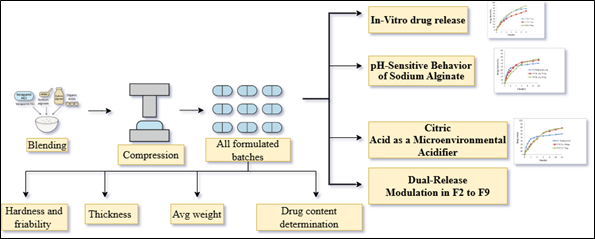
Background: Verapamil HCl, a weakly basic drug, exhibits pH-dependent solubility that limits sustained-release formulation efficacy. This study developed controlled-release matrix tablets using HPMC, sodium alginate, and organic acids to achieve pH-independent drug release. Methodology: Sixteen formulations (F1-F16) were prepared using a 2⁴ factorial design with varying concentrations of organic acids (citric/fumaric: 50-75 mg), sodium alginate (50-80 mg), and HPMC K4M (30-50 mg). Evaluations included pre- and post-compression studies, dissolution testing under a two-stage pH protocol (pH 1.2 for 2 hours, then pH 6.8 for 10 hours), microenvironmental pH monitoring, and kinetic modeling. Results and Discussion: All formulations met pharmaceutical standards, with hardness of 6.88-7.55 kg/cm², friability <0.55%, and drug content of 98.65-99.68%. Fumaric acid formulation F8 achieved superior performance with 89% drug release and the highest pH-independence (f₂ = 91.2) compared to control F1 (72% release, f₂ = 85.3). Microenvironmental pH monitoring revealed that F8 maintained sustained acidification (pH 4.10-4.75) for 12 hours, whereas citric acid formulations showed premature acid depletion. All formulations fitted the Korsmeyer-Peppas model (R² > 0.99), with F8 exhibiting diffusion-controlled release (n = 0.512). Statistical optimization identified fumaric acid as the most significant factor (F-value = 26.30, p = 0.0003). Conclusion: Incorporating 75 mg fumaric acid in HPMC-alginate matrices provides robust, pH-independent sustained release through maintained microenvironmental acidification, offering a validated solution for weakly basic drugs in sustained-release formulations.
Downloads

References
Thipe SS, Sawale AV, Muneshwar SD, Gulhane SA, Gahukar SS. Formulation and evaluation of buccoadhesive tablet of verapamil hydrochloride for the treatment of hypertension. J. Drug Deliv. Ther., 13(7), 15-23 (2023) https://doi.org/10.22270/jddt.v13i7.6122.
Grewal S, Singh S, Sharma N, Behl T, Grewal IK, Gupta S. Insights into the pivotal role of calcium channel blockers and its nanoformulations in the management of hypertension. BioNanoScience, 13, 1437-1462 (2023) https://doi.org/10.1007/s12668-023-01215-w.
Ganorkar S, Kulkarni N, Khiste R. A review on recent approaches for the use of different analytical techniques to analyze some calcium channel blockers and their combinations with other antihypertensive drugs. Curr. Indian Sci., 1(4), E2210299X250401 (2023) https://doi.org/10.2174/012210299X250401231010114247.
Patil AS, Joshi S. Formulation and evaluation of verapamil hydrochloride sustain release tablet. Res. J. Pharm. Technol., 17(2), 802-806 (2024) https://doi.org/10.52711/0974-360X.2024.00124.
Allaboun H, Alkhamis KA, Al-Nimry SS. Preparation of sustained release formulation of verapamil hydrochloride using ion exchange resins. AAPS PharmSciTech, 24(4), 114 (2023) https://doi.org/10.1208/s12249-023-02569-w.
Adimulapu A, Hussain S, Saripilli R, Jesudasan R. An in-depth analysis of pH-independent controlled drug delivery systems and prospects for the future. Preprints, 2024(8), 2097 (2024) https://doi.org/10.20944/preprints202408.2097.v1.
Chang HHR, Chen K, Lugtu-Pe JA, AL-Mousawi N, Zhang X, Bar-Shalom D, Rantanen J, Bohr A. Design and optimization of a nanoparticulate pore former as a multifunctional coating excipient for pH transition-independent controlled release of weakly basic drugs for oral drug delivery. Pharmaceutics, 15(2), 547 (2023) https://doi.org/10.3390/pharmaceutics15020547.
Shalong MH, Rahman MM, Khan RA, Islam MS. Development of pH-independent sustained release matrix tablets of verapamil hydrochloride using different organic acids. Int. J. Pharm. Sci. Res., 8(9), 3847-3856 (2017) https://doi.org/10.13040/IJPSR.0975-8232.8(9).3847-56.
Kumar A, Singh B, Rawal RK, Sharma N. Development and evaluation of pH-independent sustained release matrix tablets of verapamil hydrochloride using natural polymer. Asian J. Pharm. Clin. Res., 11(6), 245-252 (2018) https://doi.org/10.22159/ajpcr.2018.v11i6.25289.
Kumar R, Patil S, Patil MB, Paschapur MS, Mahalaxmi R. Formulation and evaluation of enteric coated tablets containing HPMCAS as a pore-former and organic acids for pH-independent drug release. Drug Dev. Ind. Pharm., 38(4), 458-466 (2012) https://doi.org/10.3109/03639045.2011.608013.
Cha KH, Shin SH, Park JH, Choi SC, Park YI, Choi WS, Cho W, Ahn JH, Kim MS, Cho KH, Hwang SJ. pH-independent sustained release tablet using polyethylene oxide and citric acid for weakly basic drug. Arch. Pharm. Res., 34(9), 1455-1462 (2011) https://doi.org/10.1007/s12272-011-0911-6.
Pooresmaeil M, Javanbakht S, Namazi H, Shaabani A. Application or function of citric acid in drug delivery platforms. Med. Res. Rev., 42(2), 800-849 (2022) https://doi.org/10.1002/med.21864.
Wang X, Li H, Bao Y, Wang Y, Chen C. Overcoming the application limitations of pH-driven encapsulation of bioactive compounds: strategies and perspectives. Curr. Opin. Food Sci., 59, 101212 (2024) https://doi.org/10.1016/j.cofs.2024.101212.
Vlad RA, Pintea A, Pintea C, Rédai EM, Antonoaea P, Bîrsan M, Ciucă A, Pădureanu V, Olariu S, Rusz CM, Mureșan ML, Ciurea CN. Hydroxypropyl methylcellulose—a key excipient in pharmaceutical drug delivery systems. Pharmaceutics, 17(6), 784 (2025) https://doi.org/10.3390/pharmaceutics17060784.
Tordi P, Ridi F, Samorì P, Bonini M. Cation‐alginate complexes and their hydrogels: a powerful toolkit for the development of next‐generation sustainable functional materials. Adv. Funct. Mater., 35(1), 2416390 (2025) https://doi.org/10.1002/adfm.202416390.
Marchetti L, Truzzi E, Rossi MC, Benvenuti S, Cappellozza S, Saviane A, Bertelli D. Alginate-based carriers loaded with mulberry (Morus alba L.) leaf extract: a promising strategy for prolonging 1-deoxynojirimicyn (DNJ) systemic activity for the nutraceutical management of hyperglycemic conditions. Molecules, 29(4), 797 (2024) https://doi.org/10.3390/molecules29040797.
Veronica N, Heng PWS, Liew CV. Alginate-based matrix tablets for drug delivery. Expert Opin. Drug Deliv., 20(1), 115-130 (2023) https://doi.org/10.1080/17425247.2023.2158183.
Dhondt J, Bertels J, Kumar A, Van Hauwermeiren D, Ryckaert A, Van Snick B, Vanhoorne V, Vercruysse J, De Beer T, Remon JP, Vervaet C. A multivariate formulation and process development platform for direct compression. Int. J. Pharm., 623, 121962 (2022) https://doi.org/10.1016/j.ijpharm.2022.121962.
Fayed MH, Aldawsari MF, AlAli AS, Alsaqr A, Almutairy BK, Aodah AH, Alshehri S, Shakeel F. Design-of-experiment approach to quantify the effect of nano-sized silica on tableting properties of microcrystalline cellulose to facilitate direct compression tableting of binary blend containing a low-dose drug. J. Drug Deliv. Sci. Technol., 68, 103127 (2022) https://doi.org/10.1016/j.jddst.2022.103127.
Canh Pham E, Vo Van L, Viet Nguyen C, Nguyen Duong NT, Le Thi TV. Formulation development, optimization, in vivo antidiabetic effect and acute toxicity of directly compressible herbal tablets containing Merremia tridentata (L.) extract. J. Drug Deliv. Sci. Technol., 84, 104445 (2023) https://doi.org/10.1016/j.jddst.2023.104445.
K S, B D. Design and evaluation of Vildagliptin matrix tablets by response surface methodology. SSRN Electron. J., 4307042 (2022) https://doi.org/10.2139/ssrn.4307042.
Balla TB, Joseph NM, Belete A. Optimization of pregelatinized Taro Boloso-I starch as a direct compression tablet excipient. BioMed Res. Int., 2023, 9981311 (2023) https://doi.org/10.1155/2023/9981311.
Caccavo D, Iannone M, Barba AA, Lamberti G. Impact of drug release in USP II and in-vitro stomach on pharmacokinetic: the case study of immediate-release carbamazepine tablets. Chem. Eng. Sci., 267, 118371 (2023) https://doi.org/10.1016/j.ces.2022.118371.
Qiu Y, Zhu DA, Apfelbaum K, Zu H, Xiong H. Development of an in vitro drug release method to enable in vitro–in vivo correlation of potassium chloride extended-release tablets. Mol. Pharm., 19(11), 4191-4198 (2022) https://doi.org/10.1021/acs.molpharmaceut.2c00568.
Vrbanac H, Trontelj J, Osojnik A, Berginc K, Janković B. Effect of gastrointestinal transit on micro-environmental pH inside HPMC matrix tablets — in vitro study. Int. J. Pharm., 604, 120718 (2021) https://doi.org/10.1016/j.ijpharm.2021.120718.
Lin JT, Chiang YC, Li PH, Chiang PY. Structural and release properties of combined curcumin controlled-release tablets formulated with chitosan/sodium alginate/HPMC. Foods, 13(13), 2022 (2024) https://doi.org/10.3390/foods13132022.
Zhang Z, Chen S, Wen M, He H, Zhang Y, Yin T, Tang X. Alleviating the influence of circadian rhythms and drug properties to the release of paliperidone gel matrix tablets with compression coating technology and microenvironment shaping. AAPS PharmSciTech, 23(7), 228 (2022) https://doi.org/10.1208/s12249-022-02388-5.
Haznar-Garbacz D, Hoc D, Garbacz G, Lachman M, Słomińska D, Romański M. Dissolution of a biopharmaceutics classification system class II free acid from immediate release tablets containing a microenvironmental pH modulator: comparison of a biorelevant bicarbonate buffering system with phosphate buffers. AAPS PharmSciTech, 23(6), 203 (2022) https://doi.org/10.1208/s12249-022-02310-z.
Zhang S, Xu X, Sun W, Zhang Z, Pan B, Hu Q. Enteric and hydrophilic polymers enhance dissolution and absorption of poorly soluble acidic drugs based on micro-environmental pH-modifying solid dispersion. Eur. J. Pharm. Sci., 168, 106074 (2022) https://doi.org/10.1016/j.ejps.2021.106074.
Kriangkrai W, Puttipipatkhachorn S, Sriamornsak P, Sungthongjeen S. Design and evaluation of new gel-based floating matrix tablets utilizing the sublimation technique for gastroretentive drug delivery. Gels, 10(9), 581 (2024) https://doi.org/10.3390/gels10090581.
Younes NF, El Assasy AEHI, Makhlouf AIA. Microenvironmental pH-modified Amisulpride-Labrasol matrix tablets: development, optimization and in vivo pharmacokinetic study. Drug Deliv. Transl. Res., 11(1), 103-117 (2021) https://doi.org/10.1007/s13346-019-00706-2.
Maghsoodi M, Asghari F, Nokhodchi A. New insight into acidifier-induced enhancement of dissolution of weakly basic drug, dipyridamole. J. Pharm. Innov., 18(4), 1626-1637 (2023) https://doi.org/10.1007/s12247-023-09730-9.
Liu Z, Shi C, Fang Y, Zhao H, Mu Y, Zhao L, Feng N. A comprehensive understanding of disintegrants and disintegration quantification techniques: from the perspective of tablet microstructure. J. Drug Deliv. Sci. Technol., 88, 104891 (2023) https://doi.org/10.1016/j.jddst.2023.104891.
Cai Z, Liu B, Zeng H, Zhang Y, Yin T, He H, Tang X. Sustained-release tablets prepared by compression coating technology achieve similar drug release to osmotic pump tablets: process parameters and in vitro-in vivo evaluation. J. Drug Deliv. Sci. Technol., 111, 107178 (2025) https://doi.org/10.1016/j.jddst.2025.107178.
Dvořáčková K, Doležel P, Mašková E, Muselík J, Kejdušová M, Vetchý D. The effect of acid pH modifiers on the release characteristics of weakly basic drug from hydrophilic-lipophilic matrices. AAPS PharmSciTech, 14, 1341-1348 (2013) https://doi.org/10.1208/s12249-013-0019-1.
Maskova E, Kubova K, Vyslouzil J, Pavlokova S, Vetchy D. Influence of pH modulation on dynamic behavior of gel layer and release of weakly basic drug from HPMC/wax matrices, controlled by acidic modifiers evaluated by multivariate data analysis. AAPS PharmSciTech, 18(4), 1242-1253 (2017) https://doi.org/10.1208/s12249-016-0588-x.
Cha KH, Shin SH, Park JH, Choi SC, Park YI, Choi WS, Cho W, Ahn JH, Kim MS, Cho KH, Hwang SJ. pH-independent sustained release tablet using polyethylene oxide and citric acid for weakly basic drug. Arch. Pharm. Res., 34(9), 1455-1462 (2011) https://doi.org/10.1007/s12272-011-0911-6.
López-Porfiri P, Gorgojo P, González-Miquel M. Solubility study and thermodynamic modelling of succinic acid and fumaric acid in bio-based solvents. J. Mol. Liq., 369, 120836 (2023) https://doi.org/10.1016/j.molliq.2022.120836.
Sohn JS, Kim JS, Choi JS. Development of a naftopidil-chitosan-based fumaric acid solid dispersion to improve the dissolution rate and stability of naftopidil. Int. J. Biol. Macromol., 176, 520-529 (2021) https://doi.org/10.1016/j.ijbiomac.2021.02.096.
Pu YE, Menger R, Tong Z, Gaebele T. Development of an enhanced formulation to minimize pharmacokinetic variabilities of a weakly basic drug compound. Pharm. Dev. Technol., 27(4), 406-413 (2022) https://doi.org/10.1080/10837450.2022.2070206.
Wu H, Ma J, Qian S, Jiang W, Liu Y, Li J, Zhang J. Co-amorphization of posaconazole using citric acid as an acidifier and a co-former for solubility improvement. J. Drug Deliv. Sci. Technol., 80, 104136 (2023) https://doi.org/10.1016/j.jddst.2022.104136.
Siraj EA, Mulualem Y, Molla F, Yayehrad AT, Belete A. Formulation optimization of furosemide floating-bioadhesive matrix tablets using waste-derived Citrus aurantifolia peel pectin as a polymer. Sci. Rep., 15(1), 16704 (2025) https://doi.org/10.1038/s41598-025-95732-1.
Streubel A, Siepmann J, Bodmeier R. Drug delivery to the upper small intestine window using gastroretentive technologies. Curr. Opin. Pharmacol., 6(5), 501-508 (2006) https://doi.org/10.1016/j.coph.2006.04.007.
Published
How to Cite
Issue
Section
Copyright (c) 2025 R U Gaware, K Sarvanan, S L Jadhav

This work is licensed under a Creative Commons Attribution-NonCommercial 4.0 International License.