Evaluation of a polyherbal formulation in gastric ulcer models induced by naproxen and acetic acid in Wistar Rats
DOI:
https://doi.org/10.69857/joapr.v13i5.1223Keywords:
Polyherbal formulation, gastric ulcers, Naproxen, acetic acid-induced ulcer, Wister rats, antiulcer activityAbstract
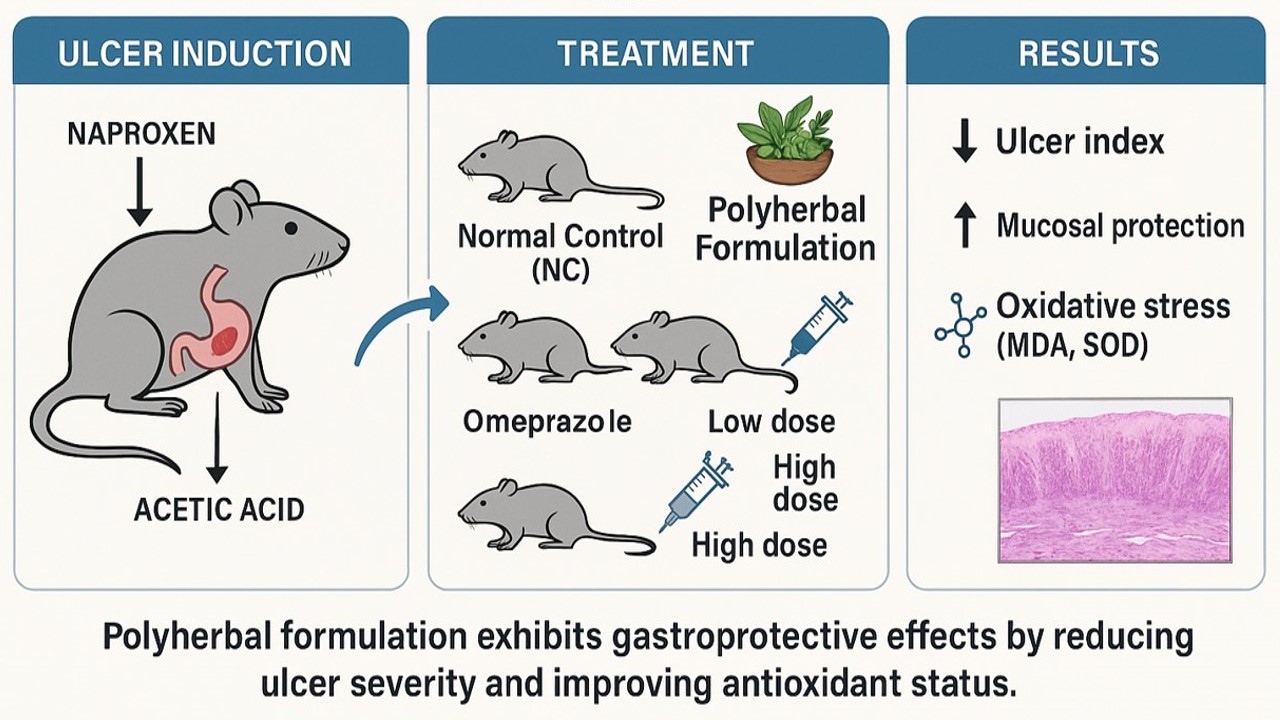
Background: Gastric ulcers remain a prevalent gastrointestinal disorder, often exacerbated by non-steroidal anti-inflammatory drugs (NSAIDs) like Naproxen and irritants such as acetic acid. The investigation focuses on evaluating the gastroprotective properties of a formulation composed of standardized extracts from traditionally used medicinal plants, evaluated in Wistar rat models with experimentally induced gastric ulcers. Methodology: Ulcers were induced using Naproxen (NSAID-induced model) and acetic acid (chronic ulcer model) to mimic acute and chronic ulcerative conditions. The polyherbal formulation was administered orally at graded doses prior to ulcer induction. Ulcer index, gastric volume, pH, and histopathological parameters were assessed to determine protective effects. Results: The polyherbal formulation significantly reduced ulcer index in a dose-dependent manner, with the highest dose (1180 mg/kg) lowering the index to 0.44 ± 0.02 in Naproxen-induced ulcers (67.45% protection) and to 2.21 ± 0.01 in acetic acid-induced ulcers (61.25% protection), closely approaching omeprazole’s efficacy. Discussion: The formulation demonstrated a significant reduction in ulcer index and improved gastric mucosal integrity, with notable restoration of antioxidant defense mechanisms. Histological studies revealed reduced mucosal damage and inflammation compared to control groups. Conclusion: These outcomes recommend that the polyherbal formulation utilizes a protective effect against gastric ulcers, likely through cytoprotective, anti-inflammatory, and antioxidant mechanisms. The study supports the therapeutic potential of polyherbal combinations in managing gastric ulcers and encourages further clinical investigation.
Downloads

References
Aiyeola A, Oluwole FS. Gastro-protective Effect of Corn Diet against Indomethacin-Induced Ulceration in Experimental Rats. JALSI, 26, 1–12 (2023) https://doi.org/10.9734/jalsi/2023/v26i4608.
Kim SH. Peptic Ulcer Disease. Korean J Helicobacter Up Gastrointest Res, 24(1), 635–639 (2024) https://doi.org/10.7704/kjhugr.2024.0075.
McEvoy L, Carr DF, Pirmohamed M. Pharmacogenomics of NSAID-Induced Upper Gastrointestinal Toxicity. Front. Pharmacol., 12, 684162 (2021) https://doi.org/10.3389/fphar.2021.684162.
Generalov E, Laryushkin D, Kritskaya K, Kulchenko N, Sinitsyn A, Yakovenko L, Generalova L, Belostotsky N. Immune Basis of Therapeutic Effects of Solanum tuberosum L. Polysaccharide on Chronic Peptic Ulcer Healing. Pharmaceuticals, 18, 502 (2025) https://doi.org/10.3390/ph18040502.
Begg M, Tarhuni M, N. Fotso M, Gonzalez NA, Sanivarapu RR, Osman U, Latha Kumar A, Sadagopan A, Mahmoud A, Khan S. Comparing the Safety and Efficacy of Proton Pump Inhibitors and Histamine-2 Receptor Antagonists in the Management of Patients With Peptic Ulcer Disease: A Systematic Review. Cureus, 15(8): e44341 (2023) https://doi.org/10.7759/cureus.44341.
Chaachouay N, Zidane L. Plant-Derived Natural Products: A Source for Drug Discovery and Development. DDC, 3, 184–207 (2024) https://doi.org/10.3390/ddc3010011.
Nair ANS, Nair RVR, Nair APR, Nair AS, Thyagarajan S, Johnson AJ, Baby S. Antidiabetes constituents, cycloartenol and 24-methylenecycloartanol, from Ficus krishnae. PLoS ONE, 15, e0235221 (2020) https://doi.org/10.1371/journal.pone.0235221.
Kumari S, Singh PA, Hazra S, Sindhwani R, Singh S. Ocimum sanctum: The Journey from Sacred Herb to Functional Food. RAFNA, 15, 83–102 (2024) https://doi.org/10.2174/012772574X290140240130101117.
Sharma M, Khichar MK, Rd A. Isolation and Identification of Phytosterols from Bignonia Venusta (L.). Asian J Pharm Clin Res, 10, 247 (2017) https://doi.org/10.22159/ajpcr.2017.v10i12.21009.
Koffuor G, Boye A, Ofori-Amoah J, Kyei S, Nouoma C, Debrah A. Evaluating Muco-suppressant, Anti-tussive and Safety Profile of Polyscias fruticosa (L.) Harms (Araliaceae) in Asthma Management. BJMMR, 10, 1–11 (2015) https://doi.org/10.9734/BJMMR/2015/19403.
Das S, Purkait K, Ali KA, Chakraborty P. Phytochemical Investigation and Hypoglycaemic Effect of Cajanus cajan. Research Journal of Pharmacy and Technology, 9, 1341–3 (2016) https://doi.org/10.5958/0974-360X.2016.00256.0
Ahlawat S, Budhwar V, Choudhary M. Enhancement of Curcumin’S Physicochemical Properties By Developing Its Eutectic Mixtures. J. Appl. Pharm. Res., 12, 71–81 (2024) https://doi.org/10.18231/j.joapr.2024.12.1.71.81.
Gorde VD, Rachh PR, Mankar S, Amin S, Gorde PL. Formulation and Development of Bilayer Tablet Containing Irbesartan and Metformin Hydrochloride for Diabetic Hypertensive Patients. J. Appl. Pharm. Res., 12, 66–74 (2024) https://doi.org/10.69857/joapr.v12i4.589.
Sruti Karmakar, Koushik Brahmachari, Suchandra Goswami, Diptendu Goswami. Gastroprotective Potential of Indian Medicinal Plants- A Comprehensive Review. MJGH, 9, 23 (1-35) (2024) https://doi.org/10.30654/MJGH.10023.
Patil AR, Maru AD. Expose the Bioactive Properties of Picrorhiza Kurroa Root Extract Oil (Pkeo): Phytochemical Composition and Therapeutic Activities. J. Appl. Pharm. Res., 12, 159–69 (2024) https://doi.org/10.69857/joapr.v12i6.841.
Isleroglu H, Turker I. Ultrasonic-assisted extraction and thermal stability of phytochemicals from fenugreek leaves. Journal of Applied Research on Medicinal and Aromatic Plants, 30, 100390 (2022) https://doi.org/10.1016/j.jarmap.2022.100390.
Kinyi HW, Tirwomwe M, Ninsiima HI, Miruka CO. Effect of Cooking Method on Vitamin C Losses and Antioxidant Activity of Indigenous Green Leafy Vegetables Consumed in Western Uganda. International Journal of Food Science, 2022, 1–7 (2022) https://doi.org/10.1155/2022/2088034.
Yusof N, David SR, Mumin NH, Ahmad L, Rajabalaya R. Formulation and development of Commiphora myrrha based polyherbal nanoemulsion mouthwash and assessment of its anti-oxidant and cytotoxicity activity. J. Appl. Pharm. Res., 12, 87–101 (2024) https://doi.org/10.69857/joapr.v12i5.679.
Hossain CM, Gera M, Ali KA. Current status and challenges of herbal drug development and regulatory aspects: a global perspective. Asian J. Pharm. Clin. Res, 15, 31–41 (2022) https://doi.org/10.22159/ajpcr.2022.v15i12.46134
Ali KA, Chakraborty R, Roy SK, Ghosal K. Design and development of Ondansetron-loaded polysaccharide-based buoyant formulation for improved gastric retention and drug release, using both natural and semi-synthetic polymers. International Journal of Biological Macromolecules, 305(1), 141105 (2025) https://doi.org/10.1016/j.ijbiomac.2025.141105.
Ish - Shalom S, Gafni A, Lichter A, Levy M. Transformation of Botrytis cinerea by direct hyphal blasting or by wound-mediated transformation of sclerotia. BMC Microbiol, 11, 266 (2011) https://doi.org/10.1186/1471-2180-11-266.
Juee LYM, Sofi SH, Adham AN. Melissa officinalis gastroprotective and antioxidant efficacy. Journal of Functional Foods, 105, 105550 (2023) https://doi.org/10.1016/j.jff.2023.105550.
Nam D, Park S-J, Omole S, Um E, Hakami RM, Hahn YS. Activated Gab1 drives hepatocyte proliferation and anti-apoptosis in liver fibrosis via potential involvement of the HGF/c-Met signaling axis. PLoS ONE, 19, e0306345 (2024) https://doi.org/10.1371/journal.pone.0306345.
Singh S, Singh RP, Sirbaiya AK. Evaluation of Phytochemical and Antistress Activity of Averrhoa carambola L. J. Adv. Zool., 44, 1192–8 (2023) https://doi.org/10.17762/jaz.v44iS-5.1160.
Tripathi A, Singh S, Mukerjee A. Antiulcer activity of ethanolic leaf extract of Capparis zeylanica against chemically induced ulcers. Future J Pharm Sci, 7, 211 (2021) https://doi.org/10.1186/s43094-021-00357-6.
Ozdemirkan A, Kucuk A, Gunes I, Arslan M, Tuncay A, Sivgin V, Sezen SC, Boyunaga H. The effect of cerium oxide on lung injury following lower extremity ischemia-reperfusion injury in rats under desflurane anesthesia. SMJ, 42, 1247–51 (2021) https://doi.org/10.15537/smj.2021.42.11.20210104.
Mohod SM, Bodhankar SL. Antiulcer activity of aqueous extract of leaves of Madhuca indica J. F. Gmel against Naproxen-induced gastric mucosal injury in rats. Journal of Acute Disease, 2, 127–33 (2013) https://doi.org/10.1016/S2221-6189(13)60112-2.
Gyires K, Rónai AZ, Zádori ZS, Tóth VE, Németh J, Szekeres M, Hunyady L. Angiotensin II-induced activation of central AT1 receptors exerts endocannabinoid-mediated gastroprotective effect in rats. Molecular and Cellular Endocrinology, 382, 971–8 (2014) https://doi.org/10.1016/j.mce.2013.10.002.
Sanpinit S, Chonsut P, Punsawad C, Wetchakul P. Gastroprotective and Antioxidative Effects of the Traditional Thai Polyherbal Formula Phy-Blica-D against Ethanol-Induced Gastric Ulcers in Rats. Nutrients, 14, 172 (2021) https://doi.org/10.3390/nu14010172.
Zádori ZS, Tóth VE, Fehér Á, Philipp K, Németh J, Gyires K. Evidence for the gastric cytoprotective effect of centrally injected agmatine. Brain Research Bulletin, 108, 51–9 (2014) https://doi.org/10.1016/j.brainresbull.2014.07.008.
Willard-Mack CL, Elmore SA, Hall WC, Harleman J, Kuper CF, Losco P, Rehg JE, Rühl-Fehlert C, Ward JM, Weinstock D, Bradley A, Hosokawa S, Pearse G, Mahler BW, Herbert RA, Keenan CM. Nonproliferative and Proliferative Lesions of the Rat and Mouse Hematolymphoid System. Toxicol Pathol, 47, 665–783 (2019) https://doi.org/10.1177/0192623319867053.
Ali G, Deeba F, Rashid U, Ullah A, Ullah H, Khan IA, Khan SI, Badshah A, Khan MA, Ayaz M, Daglia M. In vivo effects of a selected thiourea derivative 1-(2-chlorobenzoyl)-3-(2,3-dichlorophenyl) against nociception, inflammation, and gastric ulcerogenicity: Biochemical, histopathological, and in silico approaches. Biomedicine & Pharmacotherapy, 174, 116544 (2024) https://doi.org/10.1016/j.biopha.2024.116544.
Kim J-H, Kwon HJ, Kim BW. Protective effect of 4-(3,4-Dihydroxyphenyl)-3-Buten-2-One from Phellinus linteus on Naproxen-Induced Gastric Antral Ulcers in Rats. Journal of Microbiology and Biotechnology, 26, 823–8 (2016) https://doi.org/10.4014/jmb.1511.11024.
Suharti N, Armenia A, Abdillah R, Ramadan CM. Roselle calyx (Hibiscus sabdariffa L) as an anti-diabetic: ethyl acetate fraction reduces fasting blood glucose, total cholesterol, and restores pancreatic function in a diabetic model. Int J App Pharm, 16, 105–10 (2024) https://doi.org/10.22159/ijap.2024.v16s1.25.
Gupta M, Kapoor B, Gupta R, Singh N. Plants and phytochemicals for treatment of peptic ulcer: An overview. South African Journal of Botany, 138, 105–14 (2021) https://doi.org/10.1016/j.sajb.2020.11.030.
Kumadoh D, Archer M-A, Yeboah GN, Kyene MO, Boakye-Yiadom M, Adi-Dako O, Osei-Asare C, Adase E, Appiah AA, Mintah SO. A review on antiulcer activities of medicinal plants used in the formulation of Enterica, Dyspepsia, and NPK 500 capsules. Heliyon, 7, e08465 (2021) https://doi.org/10.1016/j.heliyon.2021.e08465.
Salem MB, El-Lakkany NM, Seif el-Din SH, Hammam OA, Samir S. Diosmin alleviates ulcerative colitis in mice by increasing Akkermansia muciniphila abundance, improving intestinal barrier function, and modulating the NF-κB and Nrf2 pathways. Heliyon, 10, e27527 (2024) https://doi.org/10.1016/j.heliyon.2024.e27527.
Gundersen MD, Goll R, Fenton CG, Anderssen E, Sørbye SW, Florholmen JR, Paulssen RH. Fibrosis Mediators in the Colonic Mucosa of Acute and Healed Ulcerative Colitis. Clin Transl Gastroenterol, 10, e00082 (2019) https://doi.org/10.14309/ctg.0000000000000082.
Rehman N, Ansari M, Palla A, Karim A, Imam F, Raish M, Hamad A, Noman M. Myrica salicifolia Hochst. Ex A. Rich. suppresses acetic acid-induced ulcerative colitis in rats by reducing TNF-alpha and interleukin-6, oxidative stress parameters, and improving mucosal protection. Hum Exp Toxicol, 41, 09603271221102518 (2022) https://doi.org/10.1177/09603271221102518.
Chen J, Zheng Z, Chen Y, Li J, Qian S, Shi Y, Sun L, Han Y, Zhang S, Yu K. Histone Deacetylase Inhibitors Trichostatin A and MCP30 Relieve Benzene-Induced Hematotoxicity via Restoring Topoisomerase IIα. PLoS ONE, 11, e0153330 (1-14) (2016) https://doi.org/10.1371/journal.pone.0153330.
Andargie Y, Sisay W, Molla M, Norahun A, Singh P. Evaluation of the Antiulcer Activity of Methanolic Extract and Solvent Fractions of the Leaves of Calpurnia aurea (Ait.) Benth. (Fabaceae) In rats. Evidence-Based Complementary and Alternative Medicine, 2022, 1–12 (2022) https://doi.org/10.1155/2022/4199284.
Shahzad N, Ibrahim IAA, Alzahrani AR, Al-Ghamdi SS, Alanazi IMM, Ahmad MdP, Singh AK, Alruqi MA, Shahid I, Equbal A, Azlina MFN. A comprehensive review of phytochemicals as potential therapeutic agents for stress-induced gastric ulcer. J.Umm Al-Qura Univ. Appl. Sci., 10, 793–808 (2024) https://doi.org/10.1007/s43994-024-00140-2.
Published
How to Cite
Issue
Section
Copyright (c) 2025 Kiran Niuratti Khodake, Sushil Bhargav

This work is licensed under a Creative Commons Attribution-NonCommercial 4.0 International License.